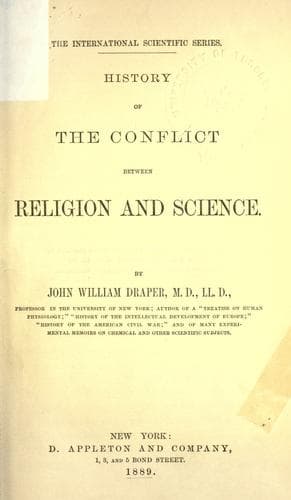
History of the Conflict Between Religion and ScienceDraper, John William
Religion
History of the Conflict Between Religion and Science
Draper, John William
Religion and science -- History
"It is a thing equally deplorable and dangerous that there are, as many
creeds as opinions among men, as many doctrines as inclinations, and as
many sources of blasphemy as there are faults among us, because we make
creeds arbitrarily and explain them as arbitrarily. Every year, nay,
every moon, we make new creeds to describe invisible mysteries; we
repent of what we have done; we defend those who repent; we anathematize
those whom we defend; we condemn either the doctrines of others in
ourselves, or our own in that of others; and, reciprocally tearing each
other to pieces, we have been the cause of each other's ruin."
These are not mere words; but the import of this self-accusation can
be realized fully only by such as are familiar with the ecclesiastical
history of those times. As soon as the first fervor of Christianity as a
system of benevolence had declined, dissensions appeared. Ecclesiastical
historians assert that "as early as the second century began the contest
between faith and reason, religion and philosophy, piety and genius." To
compose these dissensions, to obtain some authoritative expression, some
criterion of truth, assemblies for consultation were resorted to, which
eventually took the form of councils. For a long time they had nothing
more than an advisory authority; but, when, in the fourth century,
Christianity had attained to imperial rule, their dictates became
compulsory, being enforced by the civil power. By this the whole face
of the Church was changed. Oecumenical councils--parliaments of
Christianity--consisting of delegates from all the churches in the
world, were summoned by the authority of the emperor; he presided either
personally or nominally in them--composed all differences, and was, in
fact, the Pope of Christendom. Mosheim, the historian, to whom I have
more particularly referred above, speaking of these times, remarks
that "there was nothing to exclude the ignorant from ecclesiastical
preferment; the savage and illiterate party, who looked on all kinds
of learning, particularly philosophy, as pernicious to piety, was
increasing;" and, accordingly, "the disputes carried on in the Council
of Nicea offered a remarkable example of the greatest ignorance and
utter confusion of ideas, particularly in the language and explanations
of those who approved of the decisions of that council." Vast as its
influence has been, "the ancient critics are neither agreed concerning
the time nor place in which it was assembled, the number of those who
sat in it, nor the bishop who presided. No authentic acts of its famous
sentence have been committed to writing, or, at least, none have been
transmitted to our times." The Church had now become what, in the
language of modern politicians, would be called "a confederated
republic." The will of the council was determined by a majority vote,
and, to secure that, all manner of intrigues and impositions were
resorted to; the influence of court females, bribery, and violence, were
Public-domain text, read in full here on John Shaqi.
Reviews
Reviews
No reviews yet
Be the first to share your thoughts on this work.
Elsewhere in the archive
Join the Discussion
Join the discussion
Sign in to leave a comment or review.
Sign InorCreate an account