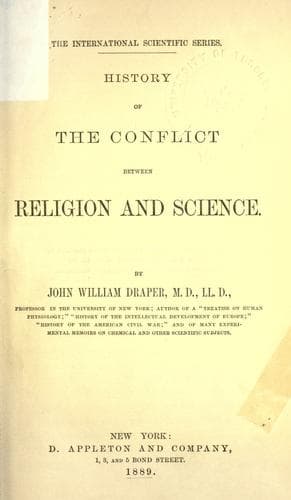
History of the Conflict Between Religion and ScienceDraper, John William
Religion
History of the Conflict Between Religion and Science
Draper, John William
Religion and science -- History
not spared. The Council of Nicea had scarcely adjourned,--when it was
plain to all impartial men that, as a method of establishing a criterion
of truth in religious matters, such councils were a total failure. The
minority had no rights which the majority need respect. The protest of
many good men, that a mere majority vote given by delegates, whose right
to vote had never been examined and authorized, could not be received
as ascertaining absolute truth, was passed over with contempt, and the
consequence was, that council was assembled against council, and their
jarring and contradictory decrees spread perplexity and confusion
throughout the Christian world. In the fourth century alone there were
thirteen councils adverse to Arius, fifteen in his favor, and seventeen
for the semi-Arians--in all, forty-five. Minorities were perpetually
attempting to use the weapon which majorities had abused.
The impartial ecclesiastical historian above quoted, moreover, says
that "two monstrous and calamitous errors were adopted in this fourth
century: 1. That it was an act of virtue to deceive and lie when, by
that means, the interests of the Church might be promoted. 2. That
errors in religion, when maintained and adhered to after proper
admonition, were punishable with civil penalties and corporal tortures."
Not without astonishment can we look back at what, in those times, were
popularly regarded as criteria of truth. Doctrines were considered
as established by the number of martyrs who had professed them, by
miracles, by the confession of demons, of lunatics, or of persons
possessed of evil spirits: thus, St. Ambrose, in his disputes with the
Arians, produced men possessed by devils, who, on the approach of the
relics of certain martyrs, acknowledged, with loud cries, that the
Nicean doctrine of the three persons of the Godhead was true. But
the Arians charged him with suborning these infernal witnesses with a
weighty bribe. Already, ordeal tribunals were making their appearance.
During the following six centuries they were held as a final resort for
establishing guilt or innocence, under the forms of trial by cold water,
by duel, by the fire, by the cross.
What an utter ignorance of the nature of evidence and its laws have we
here! An accused man sinks or swims when thrown into a pond of water;
he is burnt or escapes unharmed when he holds a piece of red-hot iron
in his hand; a champion whom he has hired is vanquished or vanquishes in
single fight; he can keep his arms outstretched like a cross, or fails
to do so longer than his accuser, and his innocence or guilt of some
imputed crime is established! Are these criteria of truth?
Is it surprising that all Europe was filled with imposture miracles
during those ages?--miracles that are a disgrace to the common-sense of
man!
Public-domain text, read in full here on John Shaqi.
Reviews
Reviews
No reviews yet
Be the first to share your thoughts on this work.
Elsewhere in the archive
Join the Discussion
Join the discussion
Sign in to leave a comment or review.
Sign InorCreate an account