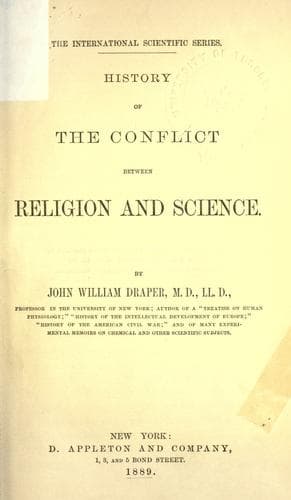
History of the Conflict Between Religion and ScienceDraper, John William
Religion
History of the Conflict Between Religion and Science
Draper, John William
Religion and science -- History
similar accusation, as is well known, was brought against the primitive
Christians by the fashionable society of Rome.
The influences of the Averroistic philosophy were apparent in many of
these sects. That Mohammedan system, considered from a Christian point
of view, led to the heretical belief that the end of the precepts of
Christianity is the union of the soul with the Supreme Being; that God
and Nature have the same relations to each other as the soul and the
body; that there is but one individual intelligence; and that one soul
performs all the spiritual and rational functions in all the human race.
When, subsequently, toward the time of the Reformation, the Italian
Averroists were required by the Inquisition to give an account of
themselves, they attempted to show that there is a wide distinction
between philosophical and religious truth; that things may be
philosophically true, and yet theologically false--an exculpatory device
condemned at length by the Lateran Council in the time of Leo X.
But, in spite of auricular confession, and the Inquisition, these
heretical tendencies survived. It has been truly said that, at the
epoch of the Reformation, there lay concealed, in many parts of Europe,
persons who entertained the most virulent enmity against Christianity.
In this pernicious class were many Aristotelians, such as Pomponatius;
many philosophers and wits, such as Bodin, Rabelais, Montaigne; many
Italians, as Leo X., Bembo, Bruno.
Miracle-evidence began to fall into discredit during the eleventh and
twelfth centuries. The sarcasms of the Hispano-Moorish philosophers
had forcibly drawn the attention of many of the more enlightened
ecclesiastics to its illusory nature. The discovery of the Pandects
of Justinian, at Amalfi, in 1130, doubtless exerted a very powerful
influence in promoting the study of Roman jurisprudence, and
disseminating better notions as to the character of legal or
philosophical evidence. Hallam has cast some doubt on the well-known
story of this discovery, but he admits that the celebrated copy in the
Laurentian library, at Florence, is the only one containing the entire
fifty books. Twenty years subsequently, the monk Gratian collected
together the various papal edicts, the canons of councils, the
declarations of the Fathers and Doctors of the Church, in a volume
called "The Decretum," considered as the earliest authority in canon
law. In the next century Gregory IX. published five books of Decretals,
and Boniface VIII. subsequently added a sixth. To these followed the
Clementine Constitutions, a seventh book of Decretals, and "A Book of
Institutes," published together, by Gregory XIII., in 1580, under the
title of "Corpus Juris Canonici." The canon law had gradually gained
enormous power through the control it had obtained over wills, the
guardianship of orphans, marriages, and divorces.
Public-domain text, read in full here on John Shaqi.
Reviews
Reviews
No reviews yet
Be the first to share your thoughts on this work.
Elsewhere in the archive
Join the Discussion
Join the discussion
Sign in to leave a comment or review.
Sign InorCreate an account