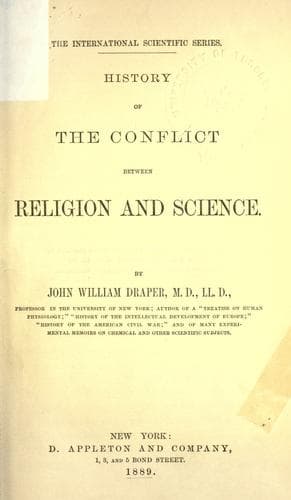
History of the Conflict Between Religion and ScienceDraper, John William
Religion
History of the Conflict Between Religion and Science
Draper, John William
Religion and science -- History
This disgrace of Christianity, and indeed of the human race, had
different constitutions in different countries. The papal Inquisition
continued the tyranny, and eventually superseded the old episcopal
inquisitions. The authority of the bishops was unceremoniously put aside
by the officers of the pope.
By the action of the fourth Lateran Council, A.D. 1215, the power of
the Inquisition was frightfully increased, the necessity of private
confession to a priest--auricular confession--being at that time
formally established. This, so far as domestic life was concerned, gave
omnipresence and omniscience to the Inquisition. Not a man was safe.
In the hands of the priest, who, at the confessional, could extract or
extort from them their most secret thoughts, his wife and his servants
were turned into spies. Summoned before the dread tribunal, he was
simply informed that he lay under strong suspicions of heresy. No
accuser was named; but the thumb-screw, the stretching-rope, the boot
and wedge, or other enginery of torture, soon supplied that defect, and,
innocent or guilty, he accused himself!
Notwithstanding all this power, the Inquisition failed of its purpose.
When the heretic could no longer confront it, he evaded it. A dismal
disbelief stealthily pervaded all Europe,--a denial of Providence,
of the immortality of the soul, of human free-will, and that man can
possibly resist the absolute necessity, the destiny which envelops him.
Ideas such as these were cherished in silence by multitudes of persons
driven to them by the tyrannical acts of ecclesiasticism. In spite of
persecution, the Waldenses still survived to propagate their declaration
that the Roman Church, since Constantine, had degenerated from its
purity and sanctity; to protest against the sale of indulgences, which
they said had nearly abolished prayer, fasting, alms; to affirm that it
was utterly useless to pray for the souls of the dead, since they must
already have gone either to heaven or hell. Though it was generally
believed that philosophy or science was pernicious to the interests of
Christianity or true piety, the Mohammedan literature then prevailing
in Spain was making converts among all classes of society. We see very
plainly its influence in many of the sects that then arose; thus, "the
Brethren and Sisters of the Free. Spirit" held that "the universe came
by emanation from God, and would finally return to him by absorption;
that rational souls are so many portions of the Supreme Deity; and that
the universe, considered as one great whole, is God." These are ideas
that can only be entertained in an advanced intellectual condition. Of
this sect it is said that many suffered burning with unclouded serenity,
with triumphant feelings of cheerfulness and joy. Their orthodox enemies
accused them of gratifying their passions at midnight assemblages in
darkened rooms, to which both sexes in a condition of nudity repaired. A
Public-domain text, read in full here on John Shaqi.
Reviews
Reviews
No reviews yet
Be the first to share your thoughts on this work.
Elsewhere in the archive
Join the Discussion
Join the discussion
Sign in to leave a comment or review.
Sign InorCreate an account