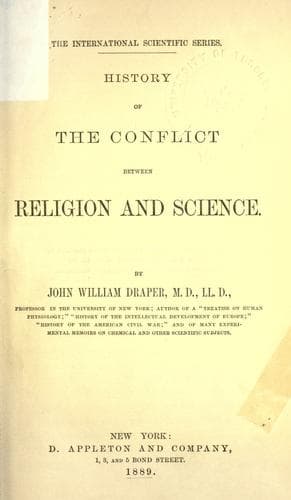
History of the Conflict Between Religion and ScienceDraper, John William
Religion
History of the Conflict Between Religion and Science
Draper, John William
Religion and science -- History
In the annals of Christianity the most ill-omened day is that in which
she separated herself from science. She compelled Origen, at that time
(A.D. 231) its chief representative and supporter in the Church, to
abandon his charge in Alexandria, and retire to Caesarea. In vain
through many subsequent centuries did her leading men spend themselves
in--as the phrase then went--"drawing forth the internal juice and
marrow of the Scriptures for the explaining of things." Universal
history from the third to the sixteenth century shows with what result.
The dark ages owe their darkness to this fatal policy. Here and there,
it is true, there were great men, such as Frederick II. and Alphonso X.,
who, standing at a very elevated and general point of view, had detected
the value of learning to civilization, and, in the midst of the dreary
prospect that ecclesiasticism had created around them, had recognized
that science alone can improve the social condition of man.
The infliction of the death-punishment for difference of opinion was
still resorted to. When Calvin caused Servetus to be burnt at Geneva, it
was obvious to every one that the spirit of persecution was unimpaired.
The offense of that philosopher lay in his belief. This was, that the
genuine doctrines of Christianity had been lost even before the time of
the Council of Nicea; that the Holy Ghost animates the whole system of
Nature, like a soul of the world, and that, with the Christ, it will
be absorbed, at the end of all things, into the substance of the Deity,
from which they had emanated. For this he was roasted to death over a
slow fire. Was there any distinction between this Protestant auto-da-fe
and the Catholic one of Vanini, who was burnt at Toulouse, by the
Inquisition, in 1629, for his "Dialogues concerning Nature?"
Public-domain text, read in full here on John Shaqi.
Reviews
Reviews
No reviews yet
Be the first to share your thoughts on this work.
Elsewhere in the archive
Join the Discussion
Join the discussion
Sign in to leave a comment or review.
Sign InorCreate an account