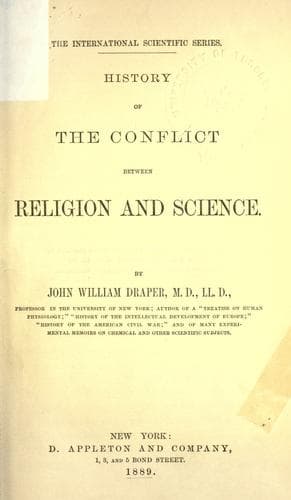
History of the Conflict Between Religion and ScienceDraper, John William
Religion
History of the Conflict Between Religion and Science
Draper, John William
Religion and science -- History
The invention of printing, the dissemination of books, had introduced
a class of dangers which the persecution of the Inquisition could not
reach. In 1559, Pope Paul IV. instituted the Congregation of the Index
Expurgatorius. "Its duty is to examine books and manuscripts intended
for publication, and to decide whether the people may be permitted to
read them; to correct those books of which the errors are not numerous,
and which contain certain useful and salutary truths, so as to bring
them into harmony with the doctrines of the Church; to condemn those
of which the principles are heretical and pernicious; and to grant the
peculiar privilege of perusing heretical books to certain persons.
This congregation, which is sometimes held in presence of the pope, but
generally in the palace of the Cardinal-president, has a more extensive
jurisdiction than that of the Inquisition, as it not only takes
cognizance of those books that contain doctrines contrary to the Roman
Catholic faith, but of those that concern the duties of morality, the
discipline of the Church, the interests of society. Its name is derived
from the alphabetical tables or indexes of heretical books and authors
composed by its appointment."
The Index Expurgatorius of prohibited books at first indicated
those works which it was unlawful to read; but, on this being found
insufficient, whatever was not permitted was prohibited--an audacious
attempt to prevent all knowledge, except such as suited the purposes of
the Church, from reaching the people.
The two rival divisions of the Christian Church--Protestant and
Catholic--were thus in accord on one point: to tolerate no science
except such as they considered to be agreeable to the Scriptures. The
Catholic, being in possession of centralized power, could make its
decisions respected wherever its sway was acknowledged, and enforce the
monitions of the Index Expurgatorius; the Protestant, whose influence
was diffused among many foci in different nations, could not act in such
a direct and resolute manner. Its mode of procedure was, by raising a
theological odium against an offender, to put him under a social ban--a
course perhaps not less effectual than the other.
Public-domain text, read in full here on John Shaqi.
Reviews
Reviews
No reviews yet
Be the first to share your thoughts on this work.
Elsewhere in the archive
Join the Discussion
Join the discussion
Sign in to leave a comment or review.
Sign InorCreate an account