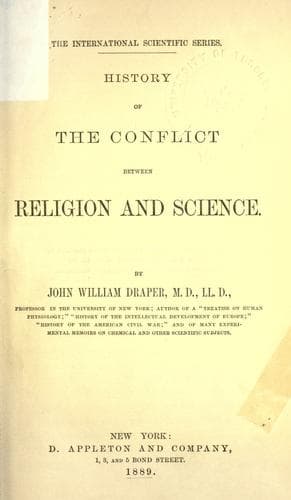
History of the Conflict Between Religion and ScienceDraper, John William
Religion
History of the Conflict Between Religion and Science
Draper, John William
Religion and science -- History
In the early Christian ages, many of the most eminent Fathers of the
Church had serious doubts respecting the authorship of the entire
Pentateuch. I have not space, in the limited compass of these pages, to
present in detail the facts and arguments that were then and have since
been adduced. The literature of the subject is now very extensive. I
may, however, refer the reader to the work of the pious and learned Dean
Prideaux, on "The Old and New Testament connected," a work which is one
of the literary ornaments of the last century. He will also find the
subject more recently and exhaustively discussed by Bishop Colenso. The
following paragraphs will convey a sufficiently distinct impression of
the present state of the controversy:
The Pentateuch is affirmed to have been written by Moses, under the
influence of divine inspiration. Considered thus, as a record vouchsafed
and dictated by the Almighty, it commands not only scientific but
universal consent.
But here, in the first place, it may be demanded, Who or what is it that
has put forth this great claim in its behalf?
Not the work itself. It nowhere claims the authorship of one man, or
makes the impious declaration that it is the writing of Almighty God.
Not until after the second century was there any such extravagant
demand on human credulity. It originated, not among the higher ranks of
Christian philosophers, but among the more fervid Fathers of the Church,
whose own writings prove them to have been unlearned and uncritical
persons.
Every age, from the second century to our times, has offered men of
great ability, both Christian and Jewish, who have altogether repudiated
these claims. Their decision has been founded upon the intrinsic
evidence of the books themselves. These furnish plain indications of at
least two distinct authors, who have been respectively termed Elohistic
and Jehovistic. Hupfeld maintains that the Jehovistic narrative bears
marks of having been a second original record, wholly independent of the
Elohistic. The two sources from which the narratives have been derived
are, in many respects, contradictory of each other. Moreover, it is
asserted that the books of the Pentateuch are never ascribed to Moses
in the inscriptions of Hebrew manuscripts, or in printed copies of the
Hebrew Bible, nor are they styled "Books of Moses" in the Septuagint or
Vulgate, but only in modern translations.
It is clear that they cannot be imputed to the sole authorship of Moses,
since they record his death. It is clear that they were not written
until many hundred years after that event, since they contain references
to facts which did not occur until after the establishment of the
government of kings among the Jews.
Public-domain text, read in full here on John Shaqi.
Reviews
Reviews
No reviews yet
Be the first to share your thoughts on this work.
Elsewhere in the archive
Join the Discussion
Join the discussion
Sign in to leave a comment or review.
Sign InorCreate an account