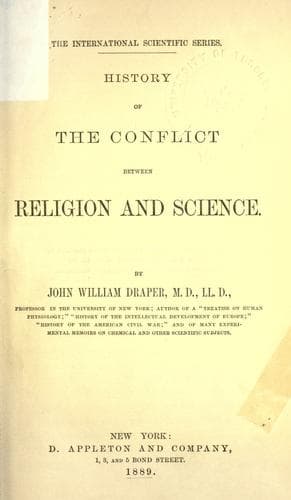
History of the Conflict Between Religion and ScienceDraper, John William
Religion
History of the Conflict Between Religion and Science
Draper, John William
Religion and science -- History
As we have seen in former chapters, an antagonism between religion and
science had existed from the earliest days of Christianity. On every
occasion permitting its display it may be detected through successive
centuries. We witness it in the downfall of the Alexandrian Museum, in
the cases of Erigena and Wiclif, in the contemptuous rejection by the
heretics of the thirteenth century of the Scriptural account of the
Creation; but it was not until the epoch of Copernicus, Kepler, and
Galileo, that the efforts of Science to burst from the thraldom in which
she was fettered became uncontrollable. In all countries the political
power of the Church had greatly declined; her leading men perceived
that the cloudy foundation on which she had stood was dissolving away.
Repressive measures against her antagonists, in old times resorted
to with effect, could be no longer advantageously employed. To her
interests the burning of a philosopher here and there did more harm than
good. In her great conflict with astronomy, a conflict in which Galileo
stands as the central figure, she received an utter overthrow; and, as
we have seen, when the immortal work of Newton was printed, she could
offer no resistance, though Leibnitz affirmed, in the face of Europe,
that "Newton had robbed the Deity of some of his most excellent
attributes, and had sapped the foundation of natural religion."
From the time of Newton to our own time, the divergence of science from
the dogmas of the Church has continually increased. The Church declared
that the earth is the central and most important body in the universe;
that the sun and moon and stars are tributary to it. On these points
she was worsted by astronomy. She affirmed that a universal deluge had
covered the earth; that the only surviving animals were such as had
been saved in an ark. In this her error was established by geology. She
taught that there was a first man, who, some six or eight thousand years
ago, was suddenly created or called into existence in a condition of
physical and moral perfection, and from that condition he fell. But
anthropology has shown that human beings existed far back in geological
time, and in a savage state but little better than that of the brute.
Many good and well-meaning men have attempted to reconcile the
statements of Genesis with the discoveries of science, but it is in
vain. The divergence has increased so much, that it has become an
absolute opposition. One of the antagonists must give way.
May we not, then, be permitted to examine the authenticity of this book,
which, since the second century, has been put forth as the criterion of
scientific truth? To maintain itself in a position so exalted, it must
challenge human criticism.
Public-domain text, read in full here on John Shaqi.
Reviews
Reviews
No reviews yet
Be the first to share your thoughts on this work.
Elsewhere in the archive
Join the Discussion
Join the discussion
Sign in to leave a comment or review.
Sign InorCreate an account