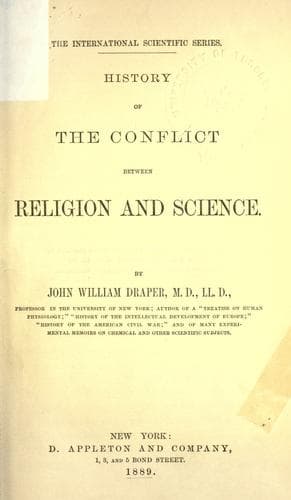
History of the Conflict Between Religion and ScienceDraper, John William
Religion
History of the Conflict Between Religion and Science
Draper, John William
Religion and science -- History
None of Kepler's contemporaries believed the law of the areas, nor was
it accepted until the publication of the "Principia" of Newton. In fact,
no one in those times understood the philosophical meaning of Kepler's
laws. He himself did not foresee what they must inevitably lead to. His
mistakes showed how far he was from perceiving their result. Thus he
thought that each planet is the seat of an intelligent principle, and
that there is a relation between the magnitudes of the orbits of the
five principal planets and the five regular solids of geometry. At first
he inclined to believe that the orbit of Mars is oval, nor was it until
after a wearisome study that he detected the grand truth, its elliptical
form. An idea of the incorruptibility of the celestial objects had
led to the adoption of the Aristotelian doctrine of the perfection of
circular motions, and to the belief that there were none but circular
motions in the heavens. He bitterly complains of this as having been a
fatal "thief of his time." His philosophical daring is illustrated in
his breaking through this time-honored tradition.
In some most important particulars Kepler anticipated Newton. He was the
first to give clear ideas respecting gravity. He says every particle of
matter will rest until it is disturbed by some other particle--that the
earth attracts a stone more than the stone attracts the earth, and that
bodies move to each other in proportion to their masses; that the earth
would ascend to the moon one-fifty-fourth of the distance, and the moon
would move toward the earth the other fifty-three. He affirms that the
moon's attraction causes the tides, and that the planets must impress
irregularities on the moon's motions.
The progress of astronomy is obviously divisible into three periods:
1. The period of observation of the apparent motions of the heavenly
bodies.
2. The period of discovery of their real motions, and particularly of
the laws of the planetary revolutions; this was signally illustrated by
Copernicus and Kepler.
3. The period of the ascertainment of the causes of those laws. It was
the epoch of Newton.
The passage of the second into the third period depended on the
development of the Dynamical branch of mechanics, which had been in
a stagnant condition from the time of Archimedes or the Alexandrian
School.
Public-domain text, read in full here on John Shaqi.
Reviews
Reviews
No reviews yet
Be the first to share your thoughts on this work.
Elsewhere in the archive
Join the Discussion
Join the discussion
Sign in to leave a comment or review.
Sign InorCreate an account