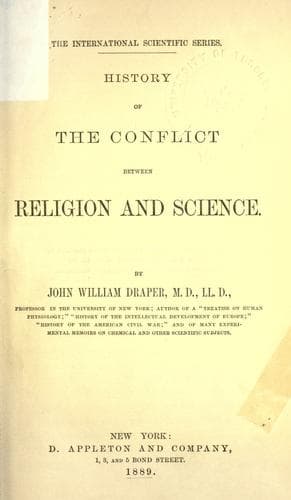
History of the Conflict Between Religion and ScienceDraper, John William
Religion
History of the Conflict Between Religion and Science
Draper, John William
Religion and science -- History
In Christian Europe there had not been a cultivator of mechanical
philosophy until Leonardo da Vinci, who was born A.D. 1452. To him, and
not to Lord Bacon, must be attributed the renaissance of science. Bacon
was not only ignorant of mathematics, but depreciated its application
to physical inquiries. He contemptuously rejected the Copernican system,
alleging absurd objections to it. While Galileo was on the brink of
his great telescopic discoveries, Bacon was publishing doubts as to
the utility of instruments in scientific investigations. To ascribe the
inductive method to him is to ignore history. His fanciful philosophical
suggestions have never been of the slightest practical use. No one has
ever thought of employing them. Except among English readers, his name
is almost unknown.
To Da Vinci I shall have occasion to allude more particularly on a
subsequent page. Of his works still remaining in manuscript, two volumes
are at Milan, and one in Paris, carried there by Napoleon. After an
interval of about seventy years, Da Vinci was followed by the Dutch
engineer, Stevinus, whose work on the principles of equilibrium was
published in 1586. Six years afterward appeared Galileo's treatise on
mechanics.
To this great Italian is due the establishment of the three fundamental
laws of dynamics, known as the Laws of Motion.
The consequences of the establishment of these laws were very important.
It had been supposed that continuous movements, such, for instance, as
those of the celestial bodies, could only be maintained by a perpetual
consumption and perpetual application of force, but the first of
Galileo's laws declared that every body will persevere in its state of
rest, or of uniform motion in a right line, until it is compelled to
change that state by disturbing forces. A clear perception of this
fundamental principle is essential to a comprehension of the elementary
facts of physical astronomy. Since all the motions that we witness
taking place on the surface of the earth soon come to an end, we are
led to infer that rest is the natural condition of things. We have made,
then, a very great advance when we have become satisfied that a body is
equally indifferent to rest as to motion, and that it equally perseveres
in either state until disturbing forces are applied. Such disturbing
forces in the case of common movements are friction and the resistance
of the air. When no such resistances exist, movement must be perpetual,
as is the case with the heavenly bodies, which are moving in a void.
Public-domain text, read in full here on John Shaqi.
Reviews
Reviews
No reviews yet
Be the first to share your thoughts on this work.
Elsewhere in the archive
Join the Discussion
Join the discussion
Sign in to leave a comment or review.
Sign InorCreate an account