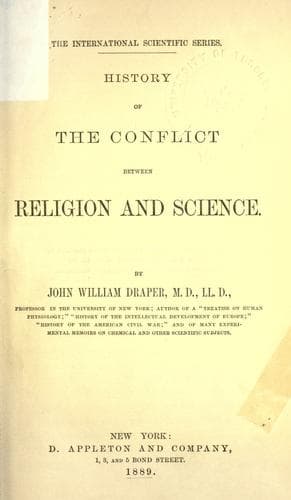
History of the Conflict Between Religion and ScienceDraper, John William
Religion
History of the Conflict Between Religion and Science
Draper, John William
Religion and science -- History
Forces, no matter what their difference of magnitude may be, will exert
their full influence conjointly, each as though the other did not exist.
Thus, when a ball is suffered to drop from the mouth of a cannon, it
falls to the ground in a certain interval of time through the influence
of gravity upon it. If, then, it be fired from the cannon, though now
it may be projected some thousands of feet in a second, the effect
of gravity upon it will be precisely the same as before. In the
intermingling of forces there is no deterioration; each produces its own
specific effect.
In the latter half of the seventeenth century, through the works of
Borelli, Hooke, and Huyghens, it had become plain that circular motions
could be accounted for by the laws of Galileo. Borelli, treating of the
motions of Jupiter's satellites, shows how a circular movement may arise
under the influence of a central force. Hooke exhibited the inflection
of a direct motion into a circular by a supervening central attraction.
The year 1687 presents, not only an epoch in European science, but also
in the intellectual development of man. It is marked by the publication
of the "Principia" of Newton, an incomparable, an immortal work.
On the principle that all bodies attract each other with forces directly
as their masses, and inversely as the squares of their distances, Newton
showed that all the movements of the celestial bodies may be accounted
for, and that Kepler's laws might all have been predicted--the elliptic
motions--the described areas the relation of the times and distances. As
we have seen, Newton's contemporaries had perceived how circular motions
could be explained; that was a special case, but Newton furnished the
solution of the general problem, containing all special cases of motion
in circles, ellipses, parabolas, hyperbolas--that is, in all the conic
sections.
Public-domain text, read in full here on John Shaqi.
Reviews
Reviews
No reviews yet
Be the first to share your thoughts on this work.
Elsewhere in the archive
Join the Discussion
Join the discussion
Sign in to leave a comment or review.
Sign InorCreate an account