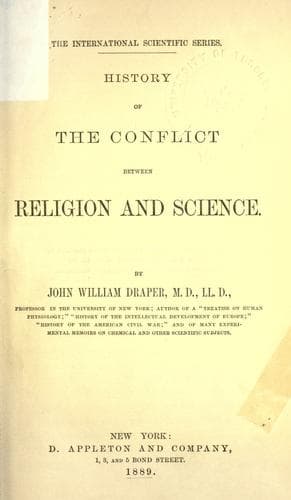
History of the Conflict Between Religion and ScienceDraper, John William
Religion
History of the Conflict Between Religion and Science
Draper, John William
Religion and science -- History
It may, therefore, be admitted that physical evidence has at length
been obtained, demonstrating the existence of vast masses of matter in a
gaseous condition, and at a temperature of incandescence. The hypothesis
of Laplace has thus a firm basis. In such a nebular mass, cooling by
radiation is a necessary incident, and condensation and rotation the
inevitable results. There must be a separation of rings all lying in
one plane, a generation of planets and satellites all rotating alike,
a central sun and engirdling globes. From a chaotic mass, through the
operation of natural laws, an organized system has been produced. An
integration of matter into worlds has taken place through a decline of
heat.
If such be the cosmogony of the solar system, such the genesis of the
planetary worlds, we are constrained to extend our views of the dominion
of law, and to recognize its agency in the creation as well as in the
conservation of the innumerable orbs that throng the universe.
But, again, it may be asked: "Is there not something profoundly impious
in this? Are we not excluding Almighty God from the world he has made?"
We have often witnessed the formation of a cloud in a serene sky. A hazy
point, barely perceptible--a little wreath of mist--increases in volume,
and becomes darker and denser, until it obscures a large portion of the
heavens. It throws itself into fantastic shapes, it gathers a glory
from the sun, is borne onward by the wind, and, perhaps, as it gradually
came, so it gradually disappears, melting away in the untroubled air.
Now, we say that the little vesicles of which this cloud was composed
arose from the condensation of water-vapor preexisting in the
atmosphere, through reduction of temperature; we show how they assumed
the form they present. We assign optical reasons for the brightness
or blackness of the cloud; we explain, on mechanical principles, its
drifting before the wind; for its disappearance we account on
the principles of chemistry. It never occurs to us to invoke the
interposition of the Almighty in the production and fashioning of this
fugitive form. We explain all the facts connected with it by physical
laws, and perhaps should reverentially hesitate to call into operation
the finger of God.
But the universe is nothing more than such a cloud--a cloud of suns and
worlds. Supremely grand though it may seem to us, to the Infinite and
Eternal Intellect it is no more than a fleeting mist. If there be a
multiplicity of worlds in infinite space, there is also a succession of
worlds in infinite time. As one after another cloud replaces cloud in
the skies, so this starry system, the universe, is the successor of
countless others that have preceded it--the predecessor of countless
others that will follow. There is an unceasing metamorphosis, a sequence
of events, without beginning or end.
Public-domain text, read in full here on John Shaqi.
Reviews
Reviews
No reviews yet
Be the first to share your thoughts on this work.
Elsewhere in the archive
Join the Discussion
Join the discussion
Sign in to leave a comment or review.
Sign InorCreate an account