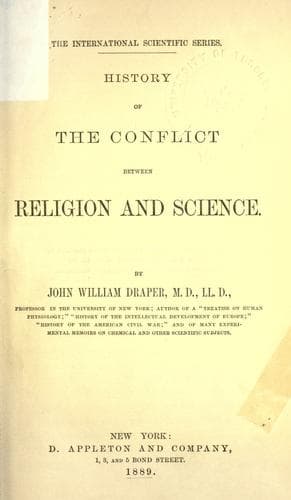
History of the Conflict Between Religion and ScienceDraper, John William
Religion
History of the Conflict Between Religion and Science
Draper, John William
Religion and science -- History
If, on physical principles, we account for minor meteorological
incidents, mists and clouds, is it not permissible for us to appeal to
the same principle in the origin of world-systems and universes, which
are only clouds on a space-scale somewhat larger, mists on a time-scale
somewhat less transient? Can any man place the line which bounds
the physical on one side, the supernatural on the other? Do not our
estimates of the extent and the duration of things depend altogether
on our point of view? Were we set in the midst of the great nebula
of Orion, how transcendently magnificent the scene! The vast
transformations, the condensations of a fiery mist into worlds, might
seem worthy of the immediate presence, the supervision of God; here, at
our distant station, where millions of miles are inappreciable to our
eyes, and suns seem no bigger than motes in the air, that nebula is more
insignificant than the faintest cloud. Galileo, in his description of
the constellation of Orion, did not think it worth while so much as to
mention it. The most rigorous theologian of those days would have seen
nothing to blame in imputing its origin to secondary causes, nothing
irreligious in failing to invoke the arbitrary interference of God in
its metamorphoses. If such be the conclusion to which we come respecting
it, what would be the conclusion to which an Intelligence seated in it
might come respecting us? It occupies an extent of space millions of
times greater than that of our solar system; we are invisible from it,
and therefore absolutely insignificant. Would such an Intelligence think
it necessary to require for our origin and maintenance the immediate
intervention of God?
From the solar system let us descend to what is still more
insignificant--a little portion of it; let us descend to our own earth.
In the lapse of time it has experienced great changes. Have these been
due to incessant divine interventions, or to the continuous operation of
unfailing law? The aspect of Nature perpetually varies under our eyes,
still more grandly and strikingly has it altered in geological
times. But the laws guiding those changes never exhibit the slightest
variation. In the midst of immense vicissitudes they are immutable.
The present order of things is only a link in a vast connected chain
reaching back to an incalculable past, and forward to an infinite
future.
There is evidence, geological and astronomical, that the temperature of
the earth and her satellite was in the remote past very much higher than
it is now. A decline so slow as to be imperceptible at short intervals,
but manifest enough in the course of many ages, has occurred. The heat
has been lost by radiation into space.
Public-domain text, read in full here on John Shaqi.
Reviews
Reviews
No reviews yet
Be the first to share your thoughts on this work.
Elsewhere in the archive
Join the Discussion
Join the discussion
Sign in to leave a comment or review.
Sign InorCreate an account