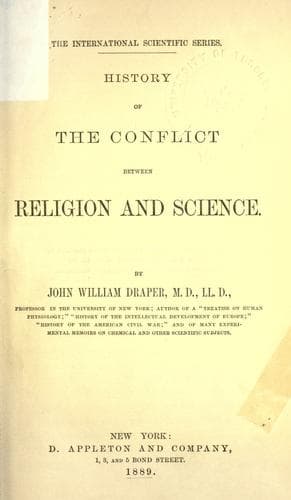
History of the Conflict Between Religion and ScienceDraper, John William
Religion
History of the Conflict Between Religion and Science
Draper, John William
Religion and science -- History
ITS RELIGIOUS CONDITION. But Greek intellectual development, due thus
in part to a more extended view of Nature, was powerfully aided by the
knowledge then acquired of the religion of the conquered country. The
idolatry of Greece had always been a horror to Persia, who, in her
invasions, had never failed to destroy the temples and insult the fanes
of the bestial gods. The impunity with which these sacrileges had
been perpetrated had made a profound impression, and did no little to
undermine Hellenic faith. But now the worshiper of the vile Olympian
divinities, whose obscene lives must have been shocking to every
pious man, was brought in contact with a grand, a solemn, a consistent
religious system having its foundation on a philosophical basis. Persia,
as is the case with all empires of long duration, had passed through
many changes of religion. She had followed the Monotheism of Zoroaster;
had then accepted Dualism, and exchanged that for Magianism. At the time
of the Macedonian expedition, she recognized one universal Intelligence,
the Creator, Preserver, and Governor of all things, the most holy
essence of truth, the giver of all good. He was not to be represented by
any image, or any graven form. And, since, in every thing here below, we
see the resultant of two opposing forces, under him were two coequal and
coeternal principles, represented by the imagery of Light and Darkness.
These principles are in never-ending conflict. The world is their
battle-ground, man is their prize.
In the old legends of Dualism, the Evil Spirit was said to have sent
a serpent to ruin the paradise which the Good Spirit had made. These
legends became known to the Jews during their Babylonian captivity.
The existence of a principle of evil is the necessary incident of the
existence of a principle of good, as a shadow is the necessary incident
of the presence of light. In this manner could be explained the
occurrence of evil in a world, the maker and ruler of which is supremely
good. Each of the personified principles of light and darkness, Ormuzd
and Ahriman, had his subordinate angels, his counselors, his armies. It
is the duty of a good man to cultivate truth, purity, and industry. He
may look forward, when this life is over, to a life in another world,
and trust to a resurrection of the body, the immortality of the soul,
and a conscious future existence.
In the later years of the empire, the principles of Magianism had
gradually prevailed more and more over those of Zoroaster. Magianism was
essentially a worship of the elements. Of these, fire was considered as
the most worthy representative of the Supreme Being. On altars erected,
not in temples, but under the blue canopy of the sky, perpetual fires
were kept burning, and the rising sun was regarded as the noblest object
of human adoration. In the society of Asia, nothing is visible but the
monarch; in the expanse of heaven, all objects vanish in presence of the
sun.
Public-domain text, read in full here on John Shaqi.
Reviews
Reviews
No reviews yet
Be the first to share your thoughts on this work.
Join the Discussion
Join the discussion
Sign in to leave a comment or review.
Sign InorCreate an account