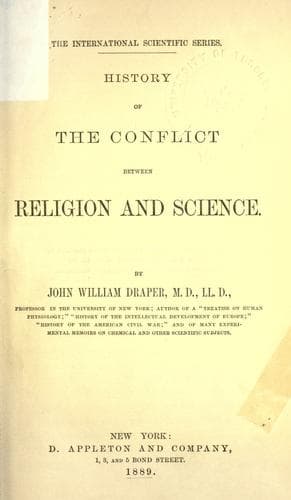
History of the Conflict Between Religion and ScienceDraper, John William
Religion
History of the Conflict Between Religion and Science
Draper, John William
Religion and science -- History
Such considerations, then, plainly force upon us the conclusion that
the organic progress of the world has been guided by the operation of
immutable law--not determined by discontinuous, disconnected, arbitrary
interventions of God. They incline us to view favorably the idea of
transmutations of one form into another, rather than that of sudden
creations.
Creation implies an abrupt appearance, transformation a gradual change.
In this manner is presented to our contemplation the great theory of
Evolution. Every organic being has a place in a chain of events. It is
not an isolated, a capricious fact, but an unavoidable phenomenon. It
has its place in that vast, orderly concourse which has successively
risen in the past, has introduced the present, and is preparing the way
for a predestined future. From point to point in this vast progression
there has been a gradual, a definite, a continuous unfolding, a
resistless order of evolution. But in the midst of these mighty changes
stand forth immutable the laws that are dominating over all.
If we examine the introduction of any type of life in the animal series,
we find that it is in accordance with transformation, not with creation.
Its beginning is under an imperfect form in the midst of other forms,
of which the time is nearly complete, and which are passing into
extinction. By degrees, one species after another in succession more and
more perfect arises, until, after many ages, a culmination is reached.
From that there is, in like manner, a long, a gradual decline.
Thus, though the mammal type of life is the characteristic of the
Tertiary and post-Tertiary periods, it does not suddenly make its
appearance without premonition in those periods. Far back, in the
Secondary, we find it under imperfect forms, struggling, as it were, to
make good a foothold. At length it gains a predominance under higher and
better models.
So, too, of reptiles, the characteristic type of life of the Secondary
period. As we see in a dissolving view, out of the fading outlines of
a scene that is passing away, the dim form of a new one emerging, which
gradually gains strength, reaches its culmination, and then melts
away in some other that is displacing it, so reptile-life doubtfully,
appears, reaches its culmination, and gradually declines. In all this
there is nothing abrupt; the changes shade into each other by insensible
degrees.
Public-domain text, read in full here on John Shaqi.
Reviews
Reviews
No reviews yet
Be the first to share your thoughts on this work.
Elsewhere in the archive
Join the Discussion
Join the discussion
Sign in to leave a comment or review.
Sign InorCreate an account