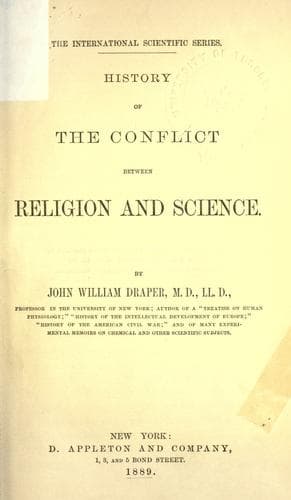
History of the Conflict Between Religion and ScienceDraper, John William
Religion
History of the Conflict Between Religion and Science
Draper, John William
Religion and science -- History
How could it be otherwise? The hot-blooded animals could not exist in
an atmosphere so laden with carbonic acid as was that of the primitive
times. But the removal of that noxious ingredient from the air by the
leaves of plants under the influence of sunlight, the enveloping of its
carbon in the earth under the form of coal, the disengagement of its
oxygen, permitted their life. As the atmosphere was thus modified,
the sea was involved in the change; it surrendered a large part of its
carbonic acid, and the limestone hitherto held in solution by it was
deposited in the solid form. For every equivalent of carbon buried in
the earth, there was an equivalent of carbonate of lime separated from
the sea--not necessarily in an amorphous condition, most frequently
under an organic form. The sunshine kept up its work day by day, but
there were demanded myriads of days for the work to be completed. It was
a slow passage from a noxious to a purified atmosphere, and an equally
slow passage from a cold-blooded to a hot-blooded type of life. But the
physical changes were taking place under the control of law, and the
organic transformations were not sudden or arbitrary providential acts.
They were the immediate, the inevitable consequences of the physical
changes, and therefore, like them, the necessary issue of law.
For a more detailed consideration of this subject, I may refer the
reader to Chapters I, II., VII, of the second book of my "Treatise on
Human Physiology," published in 1856.
Is the world, then, governed by law or by providential interventions,
abruptly breaking the proper sequence of events?
To complete our view of this question, we turn finally to what, in one
sense, is the most insignificant, in another the most important, case
that can be considered. Do human societies, in their historic career,
exhibit the marks of a predetermined progress in an unavoidable track?
Is there any evidence that the life of nations is under the control of
immutable law?
May we conclude that, in society, as in the individual man, parts never
spring from nothing, but are evolved or developed from parts that are
already in existence?
Public-domain text, read in full here on John Shaqi.
Reviews
Reviews
No reviews yet
Be the first to share your thoughts on this work.
Elsewhere in the archive
Join the Discussion
Join the discussion
Sign in to leave a comment or review.
Sign InorCreate an account