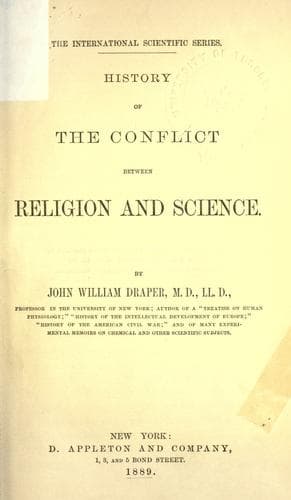
History of the Conflict Between Religion and ScienceDraper, John William
Religion
History of the Conflict Between Religion and Science
Draper, John William
Religion and science -- History
In the phases of existence of all, so far as those phases are
completed, there are common characteristics, and, as like accordances in
individuals point out that all are living under a reign of law, we
are justified in inferring that the course of nations, and indeed the
progress of humanity, does not take place in a chance or random way,
that supernatural interventions never break the chain of historic acts,
that every historic event has its warrant in some preceding event, and
gives warrant to others that are to follow..
But this conclusion is the essential principle of Stoicism--that Grecian
philosophical system which, as I have already said, offered a support in
their hour of trial and an unwavering guide in the vicissitudes of
life, not only to many illustrious Greeks, but also to some of the great
philosophers, statesmen, generals, and emperors of Rome; a system which
excluded chance from every thing, and asserted the direction of all
events by irresistible necessity, to the promotion of perfect good; a
system of earnestness, sternness, austerity, virtue--a protest in favor
of the common-sense of mankind. And perhaps we shall not dissent from
the remark of Montesquieu, who affirms that the destruction of the
Stoics was a great calamity to the human race; for they alone made great
citizens, great men.
To the principle of government by law, Latin Christianity, in its papal
form, is in absolute contradiction. The history of this branch of
the Christian Church is almost a diary of miracles and supernatural
interventions. These show that the supplications of holy men have often
arrested the course of Nature--if, indeed, there be any such course;
that images and pictures have worked wonders; that bones, hairs, and
other sacred relics, have wrought miracles. The criterion or proof of
the authenticity of many of these objects is, not an unchallengeable
record of their origin and history, but an exhibition of their
miracle-working powers.
Is not that a strange logic which finds proof of an asserted fact in an
inexplicable illustration of something else?
Even in the darkest ages intelligent Christian men must have had
misgivings as to these alleged providential or miraculous interventions.
There is a solemn grandeur in the orderly progress of Nature which
profoundly impresses us; and such is the character of continuity in the
events of our individual life that we instinctively doubt the occurrence
of the supernatural in that of our neighbor. The intelligent man knows
well that, for his personal behoof, the course of Nature has never been
checked; for him no miracle has ever been worked; he attributes justly
every event of his life to some antecedent event; this he looks upon
as the cause, that as the consequence. When it is affirmed that, in his
neighbor's behalf, such grand interventions have been vouchsafed, he
cannot do otherwise than believe that his neighbor is either deceived,
or practising deception.
Public-domain text, read in full here on John Shaqi.
Reviews
Reviews
No reviews yet
Be the first to share your thoughts on this work.
Elsewhere in the archive
Join the Discussion
Join the discussion
Sign in to leave a comment or review.
Sign InorCreate an account