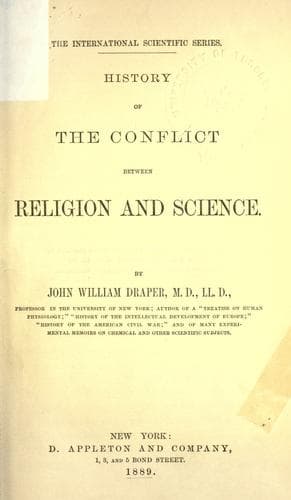
History of the Conflict Between Religion and ScienceDraper, John William
Religion
History of the Conflict Between Religion and Science
Draper, John William
Religion and science -- History
If any one should object to or deride the doctrine of the evolution
or successive development of the animated forms which constitute that
unbroken organic chain reaching from the beginning of life on the globe
to the present times, let him reflect that he has himself passed through
modifications the counterpart of those he disputes. For nine months
his type of life was aquatic, and during that time he assumed, in
succession, many distinct but correlated forms. At birth his type of
life became aerial; he began respiring the atmospheric air; new elements
of food were supplied to him; the mode of his nutrition changed; but
as yet he could see nothing, hear nothing, notice nothing. By degrees
conscious existence was assumed; he became aware that there is an
external world. In due time organs adapted to another change of food,
the teeth, appeared, and a change of food ensued. He then passed through
the stages of childhood and youth, his bodily form developing, and with
it his intellectual powers. At about fifteen years, in consequence of
the evolution which special parts of his system had attained, his moral
character changed. New ideas, new passions, influenced him. And that
that was the cause, and this the effect, is demonstrated when, by the
skill of the surgeon, those parts have been interfered with. Nor does
the development, the metamorphosis, end here; it requires many years
for the body to reach its full perfection, many years for the mind. A
culmination is at length reached, and then there is a decline. I need
not picture its mournful incidents--the corporeal, the intellectual
enfeeblement. Perhaps there is little exaggeration in saying that in
less than a century every human being on the face of the globe, if not
cut off in an untimely manner, has passed through all these changes.
Is there for each of us a providential intervention as we thus pass
from stage to stage of life? or shall we not rather believe that the
countless myriads of human beings who have peopled the earth have been
under the guidance of an unchanging, a universal law?
But individuals are the elementary constituents of communities--nations.
They maintain therein a relation like that which the particles of the
body maintain to the body itself. These, introduced into it, commence
and complete their function; they die, and are dismissed.
Like the individual, the nation comes into existence without its own
knowledge, and dies without its own consent, often against its own will.
National life differs in no particular from individual, except in this,
that it is spread over a longer span, but no nation can escape its
inevitable term. Each, if its history be well considered, shows its
time of infancy, its time of youth, its time of maturity, its time of
decline, if its phases of life be completed.
Public-domain text, read in full here on John Shaqi.
Reviews
Reviews
No reviews yet
Be the first to share your thoughts on this work.
Elsewhere in the archive
Join the Discussion
Join the discussion
Sign in to leave a comment or review.
Sign InorCreate an account