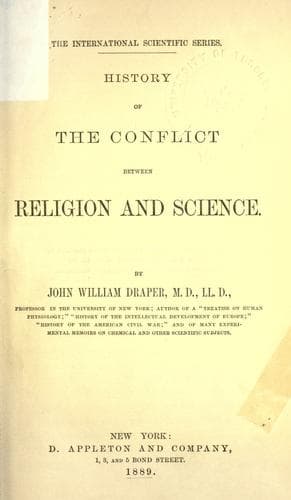
History of the Conflict Between Religion and ScienceDraper, John William
Religion
History of the Conflict Between Religion and Science
Draper, John William
Religion and science -- History
It will be convenient to limit to the case of Europe what has here to
be presented, though, from the claim of the papacy to superhuman origin,
and its demand for universal obedience, it should strictly be held to
account for the condition of all mankind. Its inefficacy against the
great and venerable religions of Southern and Eastern Asia would furnish
an important and instructive theme for consideration, and lead us to
the conclusion that it has impressed itself only where Roman imperial
influences have prevailed; a political conclusion which, however, it
contemptuously rejects.
Doubtless at the inception of the Reformation there were many persons
who compared the existing social condition with what it had been in
ancient times. Morals had not changed, intelligence had not advanced,
society had little improved. From the Eternal City itself its splendors
had vanished. The marble streets, of which Augustus had once boasted,
had disappeared. Temples, broken columns, and the long, arcaded vistas
of gigantic aqueducts bestriding the desolate Campagna, presented a
mournful scene. From the uses to which they had been respectively put,
the Capitol had been known as Goats' Hill, and the site of the Roman
Forum, whence laws had been issued to the world, as Cows' Field. The
palace of the Caesars was hidden by mounds of earth, crested with
flowering shrubs. The baths of Caracalla, with their porticoes, gardens,
reservoirs, had long ago become useless through the destruction of their
supplying aqueducts. On the ruins of that grand edifice, "flowery glades
and thickets of odoriferous trees extended in ever-winding labyrinths
upon immense platforms, and dizzy arches suspended in the air." Of
the Coliseum, the most colossal of Roman ruins, only about one-third
remained. Once capable of accommodating nearly ninety thousand
spectators, it had, in succession, been turned into a fortress in the
middle ages, and then into a stone-quarry to furnish material for the
palaces of degenerate Roman princes. Some of the popes had occupied it
as a woollen-mill, some as a saltpetre factory; some had planned the
conversion of its magnificent arcades into shops for tradesmen. The iron
clamps which bound its stones together had been stolen. The walls were
fissured and falling. Even in our own times botanical works have been
composed on the plants which have made this noble wreck their home. "The
Flora of the Coliseum" contains four hundred and twenty species.
Among the ruins of classical buildings might be seen broken columns,
cypresses, and mouldy frescoes, dropping from the walls. Even the
vegetable world participated in the melancholy change: the myrtle, which
once flourished on the Aventine, had nearly become extinct; the laurel,
which once gave its leaves to encircle the brows of emperors, had been
replaced by ivy--the companion of death.
Public-domain text, read in full here on John Shaqi.
Reviews
Reviews
No reviews yet
Be the first to share your thoughts on this work.
Elsewhere in the archive
Join the Discussion
Join the discussion
Sign in to leave a comment or review.
Sign InorCreate an account