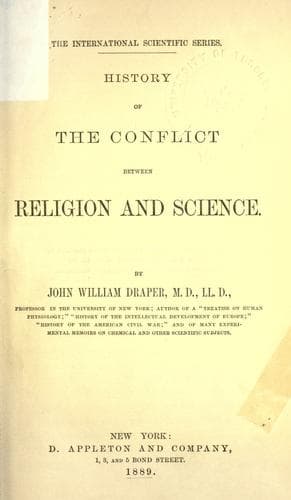
History of the Conflict Between Religion and ScienceDraper, John William
Religion
History of the Conflict Between Religion and Science
Draper, John William
Religion and science -- History
But perhaps it may be said the popes were not responsible for all this.
Let it be remembered that in less than one hundred and forty years the
city had been successively taken by Alaric, Genseric, Rieimer, Vitiges,
Totila; that many of its great edifices had been converted into
defensive works. The aqueducts were destroyed by Vitiges, who ruined the
Campagna; the palace of the Caesars was ravaged by Totila; then there
had been the Lombard sieges; then Robert Guiscard and his Normans had
burnt the city from the Antonine Column to the Flaminian Gate, from
the Lateran to the Capitol; then it was sacked and mutilated by the
Constable Bourbon; again and again it was flooded by inundations of the
Tiber and shattered by earthquakes. We must, however, bear in mind the
accusation of Machiavelli, who says, in his "History of Florence," that
nearly all the barbarian invasions of Italy were by the invitations of
the pontiffs, who called in those hordes! It was not the Goth, nor
the Vandal, nor the Norman, nor the Saracen, but the popes and their
nephews, who produced the dilapidation of Rome! Lime-kilns had been fed
from the ruins, classical buildings had become stone-quarries for the
palaces of Italian princes, and churches were decorated from the old
temples.
Churches decorated from the temples! It is for this and such as this
that the popes must be held responsible. Superb Corinthian columns bad
been chiseled into images of the saints. Magnificent Egyptian obelisks
had been dishonored by papal inscriptions. The Septizonium of Severus
had been demolished to furnish materials for the building of St.
Peter's; the bronze roof of the Pantheon had been melted into columns to
ornament the apostle's tomb.
The great bell of Viterbo, in the tower of the Capitol, had announced
the death of many a pope, and still desecration of the buildings
and demoralization of the people went on. Papal Rome manifested no
consideration, but rather hatred, for classical Rome, The pontiffs had
been subordinates of the Byzantine sovereigns, then lieutenants of the
Frankish kings, then arbiters of Europe; their government had changed as
much as those of any of the surrounding nations; there had been complete
metamorphoses in its maxims, objects, claims. In one point only it had
never changed--intolerance. Claiming to be the centre of the religious
life of Europe, it steadfastly refused to recognize any religious
existence outside of itself, yet both in a political and theological
sense it was rotten to the core. Erasmus and Luther heard with amazement
the blasphemies and witnessed with a shudder the atheism of the city.
Public-domain text, read in full here on John Shaqi.
Reviews
Reviews
No reviews yet
Be the first to share your thoughts on this work.
Elsewhere in the archive
Join the Discussion
Join the discussion
Sign in to leave a comment or review.
Sign InorCreate an account