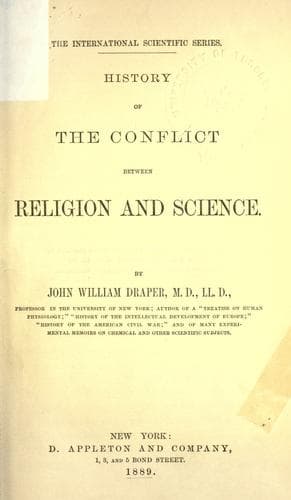
History of the Conflict Between Religion and ScienceDraper, John William
Religion
History of the Conflict Between Religion and Science
Draper, John William
Religion and science -- History
to be in circumstances of ease, if he could procure fresh meat once
a week for his dinner. The streets had no sewers; they were without
pavement or lamps. After nightfall, the chamber-shatters were thrown
open, and slops unceremoniously emptied down, to the discomfiture of the
wayfarer tracking his path through the narrow streets, with his dismal
lantern in his hand.
Aeneas Sylvius, who afterward became Pope Pius II., and was therefore a
very competent and impartial writer, has left us a graphic account of
a journey he made to the British Islands, about 1430. He describes the
houses of the peasantry as constructed of stones put together without
mortar; the roofs were of turf, a stiffened bull's-hide served for a
door. The food consisted of coarse vegetable products, such as peas,
and even the bark of trees. In some places they were unacquainted with
bread.
Cabins of reeds plastered with mud, houses of wattled stakes,
chimneyless peat-fires from which there was scarcely an escape for the
smoke, dens of physical and moral pollution swarming with vermin, wisps
of straw twisted round the limbs to keep off the cold, the ague-stricken
peasant, with no help except shrine-cure! How was it possible that the
population could increase? Shall we, then, wonder that, in the famine of
1030, human flesh was cooked and sold; or that, in that of 1258, fifteen
thousand persons died of hunger in London? Shall we wonder that, in some
of the invasions of the plague, the deaths were so frightfully numerous
that the living could hardly bury the dead? By that of 1348, which came
from the East along the lines of commercial travel, and spread all over
Europe, one-third of the population of France was destroyed.
Such was the condition of the peasantry, and of the common inhabitants
of cities. Not much better was that of the nobles. William of
Malmesbury, speaking of the degraded manners of the Anglo-Saxons, says:
"Their nobles, devoted to gluttony and voluptuousness, never visited the
church, but the matins and the mass were read over to them by a hurrying
priest in their bedchambers, before they rose, themselves not listening.
The common people were a prey to the more powerful; their property was
seized, their bodies dragged away to distant countries; their maidens
were either thrown into a brothel, or sold for slaves. Drinking day
and night was the general pursuit; vices, the companions of inebriety,
followed, effeminating the manly mind." The baronial castles were dens
of robbers. The Saxon chronicler records how men and women were caught
and dragged into those strongholds, hung up by their thumbs or feet,
fire applied to them, knotted strings twisted round their heads, and
many other torments inflicted to extort ransom.
Public-domain text, read in full here on John Shaqi.
Reviews
Reviews
No reviews yet
Be the first to share your thoughts on this work.
Elsewhere in the archive
Join the Discussion
Join the discussion
Sign in to leave a comment or review.
Sign InorCreate an account