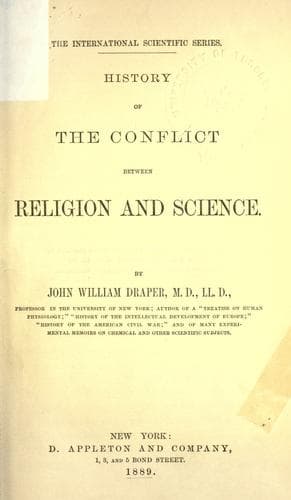
History of the Conflict Between Religion and ScienceDraper, John William
Religion
History of the Conflict Between Religion and Science
Draper, John William
Religion and science -- History
"To an American, who lives in a country that was yesterday an
interminable and impenetrable desert, but which to-day is filling with
a population doubling itself every twenty-five years at the prescribed
rate, this awful waste of actual and contingent life cannot but be a
most surprising fact. His curiosity will lead him to inquire what kind
of system that could have been which was pretending to guide and
develop society, but which must be held responsible for this prodigious
destruction, excelling, in its insidious result, war, pestilence, and
famine combined; insidious, for men were actually believing that it
secured their highest temporal interests. How different now! In England,
the same geographical surface is sustaining ten times the population
of that day, and sending forth its emigrating swarms. Let him, who looks
back, with veneration on the past, settle in his own mind what such a
system could have been worth."
These variations in the population of Europe have been attended with
changes in distribution. The centre of population has passed northward
since the establishment of Christianity in the Roman Empire. It
has since passed westward, in consequence of the development of
manufacturing industry.
We may now examine somewhat more minutely the character of the
resistances which thus, for a thousand years, kept the population of
Europe stationary. The surface of the Continent was for the most
part covered with pathless forests; here and there it was dotted with
monasteries and towns. In the lowlands and along the river-courses were
fens, sometimes hundreds of miles in extent, exhaling their pestiferous
miasms, and spreading agues far and wide. In Paris and London, the
houses were of wood daubed with clay, and thatched with straw or reeds.
They had no windows, and, until the invention of the saw-mill, very
few had wooden floors. The luxury of a carpet was unknown; some straw,
scattered in the room, supplied its place. There were no chimneys; the
smoke of the ill-fed, cheerless fire escaped through a hole in the roof.
In such habitations there was scarcely any protection from the weather.
No attempt was made at drainage, but the putrefying garbage and rubbish
were simply thrown out of the door. Men, women, and children, slept
in the same apartment; not unfrequently, domestic animals were their
companions; in such a confusion of the family, it was impossible that
modesty or morality could be maintained. The bed was usually a bag of
straw, a wooden log served as a pillow. Personal cleanliness was utterly
unknown; great officers of state, even dignitaries so high as the
Archbishop of Canterbury, swarmed with vermin; such, it is related, was
the condition of Thomas a Becket, the antagonist of an English king. To
conceal personal impurity, perfumes were necessarily and profusely
used. The citizen clothed himself in leather, a garment which, with its
ever-accumulating impurity, might last for many years. He was considered
Public-domain text, read in full here on John Shaqi.
Reviews
Reviews
No reviews yet
Be the first to share your thoughts on this work.
Elsewhere in the archive
Join the Discussion
Join the discussion
Sign in to leave a comment or review.
Sign InorCreate an account