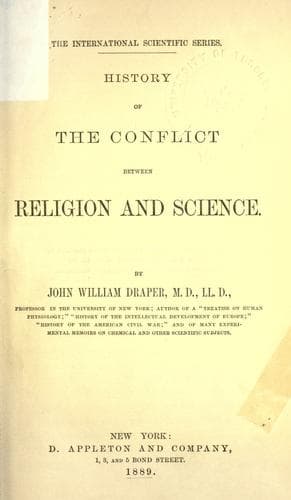
History of the Conflict Between Religion and ScienceDraper, John William
Religion
History of the Conflict Between Religion and Science
Draper, John William
Religion and science -- History
The moral condition of Europe was signally illustrated when syphilis was
introduced from the West Indies by the companions of Columbus. It spread
with wonderful rapidity; all ranks of persons, from the Holy Father Leo
X. to the beggar by the wayside, contracting the shameful disease. Many
excused their misfortune by declaring that it was an epidemic proceeding
from a certain malignity in the constitution of the air, but in truth
its spread was due to a certain infirmity in the constitution of man--an
infirmity which had not been removed by the spiritual guidance under
which he had been living.
To the medical efficacy of shrines must be added that of special relics.
These were sometimes of the most extraordinary kind. There were several
abbeys that possessed our Savior's crown of thorns. Eleven had the
lance that had pierced his side. If any person was adventurous enough
to suggest that these could not all be authentic, he would have been
denounced as an atheist. During the holy wars the Templar-Knights had
driven a profitable commerce by bringing from Jerusalem to the Crusading
armies bottles of the milk of the Blessed Virgin, which they sold for
enormous sums; these bottles were preserved with pious care in many of
the great religious establishments. But perhaps none of these impostures
surpassed in audacity that offered by a monastery in Jerusalem, which
presented to the beholder one of the fingers of the Holy Ghost! Modern
society has silently rendered its verdict on these scandalous objects.
Though they once nourished the piety of thousands of earnest people,
they are now considered too vile to have a place in any public museum.
How shall we account for the great failure we thus detect in the
guardianship of the Church over Europe? This is not the result that
must have occurred had there been in Rome an unremitting care for the
spiritual and material prosperity of the continent, had the universal
pastor, the successor of Peter, occupied himself with singleness of
purpose for the holiness and happiness of his flock.
The explanation is not difficult to find. It is contained in a story
of sin and shame. I prefer, therefore, in the following paragraphs, to
offer explanatory facts derived from Catholic authors, and, indeed, to
present them as nearly as I can in the words of those writers.
The story I am about to relate is a narrative of the transformation of a
confederacy into an absolute monarchy.
In the early times every church, without prejudice to its agreement with
the Church universal in all essential points, managed its own affairs
with perfect freedom and independence, maintaining its own traditional
usages and discipline, all questions not concerning the whole Church, or
of primary importance, being settled on the spot.
Public-domain text, read in full here on John Shaqi.
Reviews
Reviews
No reviews yet
Be the first to share your thoughts on this work.
Elsewhere in the archive
Join the Discussion
Join the discussion
Sign in to leave a comment or review.
Sign InorCreate an account