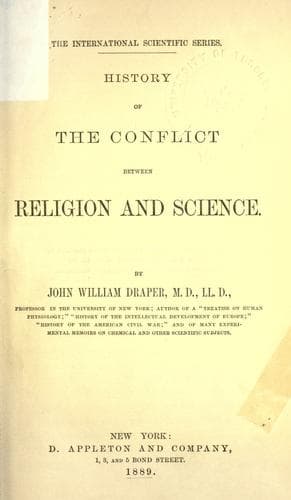
History of the Conflict Between Religion and ScienceDraper, John William
Religion
History of the Conflict Between Religion and Science
Draper, John William
Religion and science -- History
Until the beginning of the ninth century, there was no change in the
constitution of the Roman Church. But about 845 the Isidorian Decretals
were fabricated in the west of Gaul--a forgery containing about one
hundred pretended decrees of the early popes, together with certain
spurious writings of other church dignitaries and acts of synods. This
forgery produced an immense extension of the papal power, it displaced
the old system of church government, divesting it of the republican
attributes it had possessed, and transforming it into an absolute
monarchy. It brought the bishops into subjection to Rome, and made the
pontiff the supreme judge of the clergy of the whole Christian world. It
prepared the way for the great attempt, subsequently made by Hildebrand,
to convert the states of Europe into a theocratic priest-kingdom, with
the pope at its head.
Gregory VII., the author of this great attempt, saw that his plans
would be best carried out through the agency of synods. He, therefore,
restricted the right of holding them to the popes and their legates. To
aid in the matter, a new system of church law was devised by Anselm
of Lucca, partly from the old Isidorian forgeries, and partly from new
inventions. To establish the supremacy of Rome, not only had a new
civil and a new canon law to be produced, a new history had also to
be invented. This furnished needful instances of the deposition
and excommunication of kings, and proved that they had always been
subordinate to the popes. The decretal letters of the popes were put on
a par with Scripture. At length it came to be received, throughout
the West, that the popes had been, from the beginning of Christianity,
legislators for the whole Church. As absolute sovereigns in later times
cannot endure representative assemblies, so the papacy, when it wished
to become absolute, found that the synods of particular national
churches must be put an end to, and those only under the immediate
control of the pontiff permitted. This, in itself, constituted a great
revolution.
Another fiction concocted in Rome in the eighth century led to important
consequences. It feigned that the Emperor Constantine, in gratitude for
his cure from leprosy, and baptism by Pope Sylvester, had bestowed
Italy and the Western provinces on the pope, and that, in token of his
subordination, he had served the pope as his groom, and led his horse
some distance. This forgery was intended to work on the Frankish kings,
to impress them with a correct idea of their inferiority, and to show
that, in the territorial concessions they made to the Church, they were
not giving but only restoring what rightfully belonged to it.
Public-domain text, read in full here on John Shaqi.
Reviews
Reviews
No reviews yet
Be the first to share your thoughts on this work.
Elsewhere in the archive
Join the Discussion
Join the discussion
Sign in to leave a comment or review.
Sign InorCreate an account