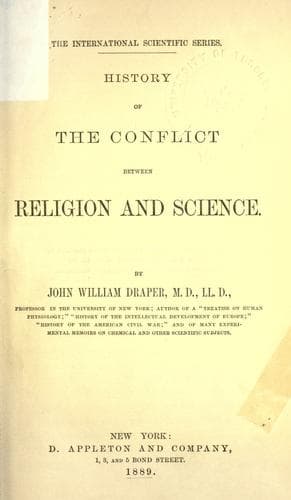
History of the Conflict Between Religion and ScienceDraper, John William
Religion
History of the Conflict Between Religion and Science
Draper, John William
Religion and science -- History
NEED OF A GENERAL COUNCIL. The Inquisition had made the papal system
irresistible. All opposition must be punished with death by fire. A mere
thought, without having betrayed itself by outward sign, was considered
as guilt. As time went on, this practice of the Inquisition became
more and more atrocious. Torture was resorted to on mere suspicion.
The accused was not allowed to know the name of his accuser. He was
not permitted to have any legal adviser. There was no appeal. The
Inquisition was ordered not to lean to pity. No recantation was of
avail. The innocent family of the accused was deprived of its
property by confiscation; half went to the papal treasury, half to the
inquisitors. Life only, said Innocent III., was to be left to the sons
of misbelievers, and that merely as an act of mercy. The consequence
was, that popes, such as Nicolas III., enriched their families through
plunder acquired by this tribunal. Inquisitors did the same habitually.
The struggle between the French and Italians for the possession of the
papacy inevitably led to the schism of the fourteenth century. For more
than forty years two rival popes were now anathematizing each other,
two rival Curias were squeezing the nations for money. Eventually, there
were three obediences, and triple revenues to be extorted. Nobody, now,
could guarantee the validity of the sacraments, for nobody could be
sure which was the true pope. Men were thus compelled to think for
themselves. They could not find who was the legitimate thinker for them.
They began to see that the Church must rid herself of the curialistic
chains, and resort to a General Council. That attempt was again and
again made, the intention being to raise the Council into a Parliament
of Christendom, and make the pope its chief executive officer. But the
vast interests that had grown out of the corruption of ages could not
so easily be overcome; the Curia again recovered its ascendency, and
ecclesiastical trading was resumed. The Germans, who had never been
permitted to share in the Curia, took the leading part in these attempts
at reform. As things went on from bad to worse, even they at last found
out that all hope of reforming the Church by means of councils was
delusive. Erasmus exclaimed, "If Christ does not deliver his people
from this multiform ecclesiastical tyranny, the tyranny of the Turk will
become less intolerable." Cardinals' hats were now sold, and under Leo
X. ecclesiastical and religious offices were actually put up to auction.
The maxim of life had become, interest first, honor afterward. Among
the officials, there was not one who could be honest in the dark, and
virtuous without a witness. The violet-colored velvet cloaks and white
ermine capes of the cardinals were truly a cover for wickedness.
Public-domain text, read in full here on John Shaqi.
Reviews
Reviews
No reviews yet
Be the first to share your thoughts on this work.
Elsewhere in the archive
Join the Discussion
Join the discussion
Sign in to leave a comment or review.
Sign InorCreate an account