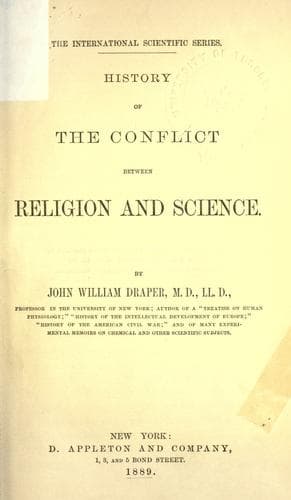
History of the Conflict Between Religion and ScienceDraper, John William
Religion
History of the Conflict Between Religion and Science
Draper, John William
Religion and science -- History
Toward the close of the eleventh century the Roman Church became the
Roman court. In place of the Christian sheep gently following their
shepherd in the holy precincts of the city, there had arisen a
chancery of writers, notaries, tax-gatherers, where transactions about
privileges, dispensations, exemptions, were carried on; and suitors
went with petitions from door to door. Rome was a rallying-point for
place-hunters of every nation. In presence of the enormous mass of
business-processes, graces, indulgences, absolutions, commands, and
decisions, addressed to all parts of Europe and Asia, the functions
of the local church sank into insignificance. Several hundred persons,
whose home was the Curia, were required. Their aim was to rise in it by
enlarging the profits of the papal treasury. The whole Christian
world had become tributary to it. Here every vestige of religion had
disappeared; its members were busy with politics, litigations, and
processes; not a word could be heard about spiritual concerns. Every
stroke of the pen had its price. Benefices, dispensations, licenses,
absolutions, indulgences, privileges, were bought and sold like
merchandise. The suitor had to bribe every one, from the doorkeeper
to the pope, or his case was lost. Poor men could neither attain
preferment, nor hope for it; and the result was, that every cleric felt
he had a right to follow the example he had seen at Rome, and that
he might make profits out of his spiritual ministries and sacraments,
having bought the right to do so at Rome, and having no other way to
pay off his debt. The transference of power from Italians to Frenchmen,
through the removal of the Curia to Avignon, produced no change--only
the Italians felt that the enrichment of Italian families had slipped
out of their grasp. They had learned to consider the papacy as their
appanage, and that they, under the Christian dispensation, were God's
chosen people, as the Jews had been under the Mosaic.
At the end of the thirteenth century a new kingdom was discovered,
capable of yielding immense revenues. This was Purgatory. It was shown
that the pope could empty it by his indulgences. In this there was no
need of hypocrisy. Things were done openly. The original germ of the
apostolic primacy had now expanded into a colossal monarchy.
Public-domain text, read in full here on John Shaqi.
Reviews
Reviews
No reviews yet
Be the first to share your thoughts on this work.
Elsewhere in the archive
Join the Discussion
Join the discussion
Sign in to leave a comment or review.
Sign InorCreate an account