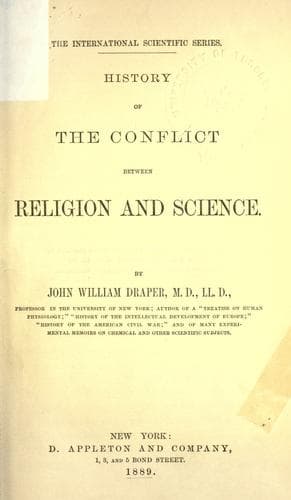
History of the Conflict Between Religion and ScienceDraper, John William
Religion
History of the Conflict Between Religion and Science
Draper, John William
Religion and science -- History
CATHOLICITY AND CIVILIZATION. In the old times of Roman domination the
encampments of the legions in the provinces had always proved to be foci
of civilization. The industry and order exhibited in them presented an
example not lost on the surrounding barbarians of Britain, Gaul, and
Germany. And, though it was no part of their duty to occupy themselves
actively in the betterment of the conquered tribes, but rather to keep
them in a depressed condition that aided in maintaining subjection,
a steady improvement both in the individual and social condition took
place.
Under the ecclesiastical domination of Rome similar effects occurred. In
the open country the monastery replaced the legionary encampment; in the
village or town, the church was a centre of light. A powerful effect
was produced by the elegant luxury of the former, and by the sacred and
solemn monitions of the latter.
In extolling the papal system for what it did in the organization of the
family, the definition of civil policy, the construction of the states
of Europe, our praise must be limited by the recollection that the chief
object of ecclesiastical policy was the aggrandizement of the Church,
not the promotion of civilization. The benefit obtained by the laity was
not through any special intention, but incidental or collateral.
There was no far-reaching, no persistent plan to ameliorate the physical
condition of the nations. Nothing was done to favor their intellectual
development; indeed, on the contrary, it was the settled policy to keep
them not merely illiterate, but ignorant. Century after century passed
away, and left the peasantry but little better than the cattle in the
fields. Intercommunication and locomotion, which tend so powerfully to
expand the ideas, received no encouragement; the majority of men died
without ever having ventured out of the neighborhood in which they were
born. For them there was no hope of personal improvement, none of the
bettering of their lot; there were no comprehensive schemes for the
avoidance of individual want, none for the resistance of famines.
Pestilences were permitted to stalk forth unchecked, or at best opposed
only by mummeries. Bad food, wretched clothing, inadequate shelter, were
suffered to produce their result, and at the end of a thousand years the
population of Europe had not doubled.
If policy may be held accountable as much for the births it prevents as
for the deaths it occasions, what a great responsibility there is here!
Public-domain text, read in full here on John Shaqi.
Reviews
Reviews
No reviews yet
Be the first to share your thoughts on this work.
Elsewhere in the archive
Join the Discussion
Join the discussion
Sign in to leave a comment or review.
Sign InorCreate an account