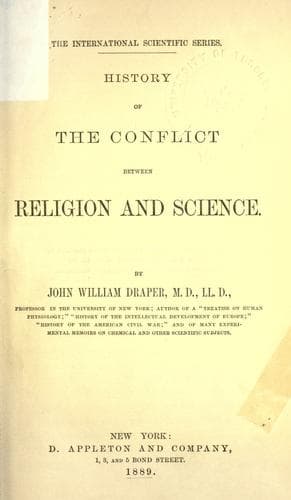
History of the Conflict Between Religion and ScienceDraper, John William
Religion
History of the Conflict Between Religion and Science
Draper, John William
Religion and science -- History
In this investigation of the influence of Catholicism, we must carefully
keep separate what it did for the people and what it did for itself.
When we think of the stately monastery, an embodiment of luxury, with
its closely-mown lawns, its gardens and bowers, its fountains and many
murmuring streams, we must connect it not with the ague-stricken peasant
dying without help in the fens, but with the abbot, his ambling palfrey,
his hawk and hounds, his well-stocked cellar and larder. He is part of
a system that has its centre of authority in Italy.. To that his
allegiance is due. For its behoof are all his acts. When we survey, as
still we may, the magnificent churches and cathedrals of those
times, miracles of architectural skill--the only real miracles of
Catholicism--when in imagination we restore the transcendently
imposing, the noble services of which they were once the scene, the
dim, religious-light streaming in through the many-colored windows, the
sounds of voices not inferior in their melody to those of heaven,
the priests in their sacred vestments, and above all the prostrate
worshipers listening to litanies and prayers in a foreign and unknown
tongue, shall we not ask ourselves, Was all this for the sake of those
worshipers, or for the glory of the great, the overshadowing authority
at Rome?
But perhaps some one may say, Are there not limits to human
exertion--things which no political system, no human power, no matter
how excellent its intention, can accomplish? Men cannot be raised from
barbarism, a continent cannot be civilized, in a day!
The Catholic power is not, however, to be tried by any such standard.
It scornfully rejected and still rejects a human origin. It claims to
be accredited supernaturally. The sovereign pontiff is the Vicar of God
upon earth. Infallible in judgment, it is given to him to accomplish
all things by miracle if need be. He had exercised an autocratic tyranny
over the intellect of Europe for more than a thousand years; and, though
on some occasions he had encountered the resistances of disobedient
princes, these, in the aggregate, were of so little moment, that the
physical, the political power of the continent may be affirmed to have
been at his disposal.
Public-domain text, read in full here on John Shaqi.
Reviews
Reviews
No reviews yet
Be the first to share your thoughts on this work.
Elsewhere in the archive
Join the Discussion
Join the discussion
Sign in to leave a comment or review.
Sign InorCreate an account