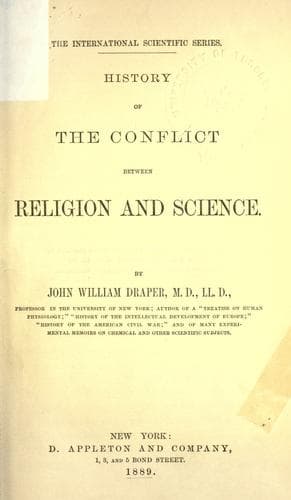
History of the Conflict Between Religion and ScienceDraper, John William
Religion
History of the Conflict Between Religion and Science
Draper, John William
Religion and science -- History
INTRODUCTION OF SCIENCE INTO EUROPE. Not only had the Crusades, for many
years, brought vast sums to Rome, extorted from the fears or the piety
of every Christian nation; they had also increased the papal power to a
most dangerous extent. In the dual governments everywhere prevailing in
Europe, the spiritual had obtained the mastery; the temporal was little
better than its servant.
From all quarters, and under all kinds of pretenses, streams of money
were steadily flowing into Italy. The temporal princes found that there
were left for them inadequate and impoverished revenues. Philip the
Fair, King of France (A.D. 1300), not only determined to check this
drain from his dominions, by prohibiting the export of gold and
silver without his license; he also resolved that the clergy and the
ecclesiastical estates should pay their share of taxes to him.
This brought on a mortal contest with the papacy. The king was
excommunicated, and, in retaliation, he accused the pope, Boniface
VIII., of atheism; demanding that he should be tried by a general
council. He sent some trusty persons into Italy, who seized Boniface in
his palace at Anagni, and treated him with so much severity, that in a
few days he died. The succeeding pontiff, Benedict XI., was poisoned.
The French king was determined that the papacy should be purified and
reformed; that it should no longer be the appanage of a few Italian
families, who were dexterously transmuting the credulity of Europe into
coin--that French influence should prevail in it. He Therefore came to
an understanding with the cardinals; a French archbishop was elevated
to the pontificate; he took the name of Clement V. The papal court was
removed to Avignon, in France, and Rome was abandoned as the metropolis
of Christianity.
Public-domain text, read in full here on John Shaqi.
Reviews
Reviews
No reviews yet
Be the first to share your thoughts on this work.
Elsewhere in the archive
Join the Discussion
Join the discussion
Sign in to leave a comment or review.
Sign InorCreate an account