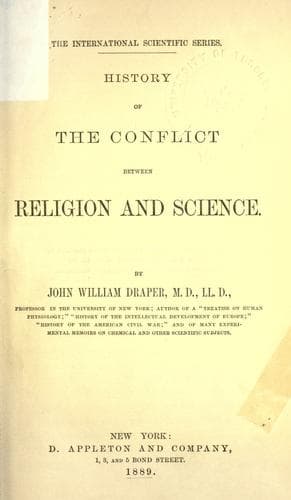
History of the Conflict Between Religion and ScienceDraper, John William
Religion
History of the Conflict Between Religion and Science
Draper, John William
Religion and science -- History
MOORISH SCIENCE INTRODUCED THROUGH FRANCE. Seventy years elapsed before
the papacy was restored to the Eternal City (A.D. 1376). The diminution
of its influence in the peninsula, that had thus occurred, gave
opportunity for the memorable intellectual movement which soon
manifested itself in the great commercial cities of Upper Italy.
Contemporaneously, also, there were other propitious events. The result
of the Crusades had shaken the faith of all Christendom. In an age when
the test of the ordeal of battle was universally accepted, those wars
had ended in leaving the Holy Land in the hands of the Saracens; the
many thousand Christian warriors who had returned from them did not
hesitate to declare that they had found their antagonists not such as
had been pictured by the Church, but valiant, courteous, just. Through
the gay cities of the South of France a love of romantic literature
had been spreading; the wandering troubadours had been singing their
songs--songs far from being restricted to ladye-love and feats of war;
often their burden was the awful atrocities that had been perpetrated
by papal authority--the religious massacres of Languedoc; often their
burden was the illicit amours of the clergy. From Moorish Spain the
gentle and gallant idea of chivalry had been brought, and with it the
noble sentiment of "personal honor," destined in the course of time to
give a code of its own to Europe.
EFFECT OF THE GREAT SCHISM. The return of the papacy to Rome was far
from restoring the influence of the popes over the Italian Peninsula.
More than two generations had passed away since their departure, and,
had they come back even in their original strength, they could not
have resisted the intellectual progress that had been made during their
absence. The papacy, however, came back not to rule, but to be divided
against itself, to encounter the Great Schism. Out of its dissensions
emerged two rival popes; eventually there were three, each pressing
his claims upon the religious, each cursing his rival. A sentiment
of indignation soon spread all over Europe, a determination that the
shameful scenes which were then enacting should be ended. How could the
dogma of a Vicar of God upon earth, the dogma of an infallible pope,
be sustained in presence of such scandals? Herein lay the cause of that
resolution of the ablest ecclesiastics of those times (which, alas for
Europe! could not be carried into effect), that a general council should
be made the permanent religious parliament of the whole continent,
with the pope as its chief executive officer. Had that intention been
accomplished, there would have been at this day no conflict between
science and religion; the convulsion of the Reformation would have been
avoided; there would have been no jarring Protestant sects. But the
Councils of Constance and Basle failed to shake off the Italian yoke,
failed to attain that noble result.
Public-domain text, read in full here on John Shaqi.
Reviews
Reviews
No reviews yet
Be the first to share your thoughts on this work.
Elsewhere in the archive
Join the Discussion
Join the discussion
Sign in to leave a comment or review.
Sign InorCreate an account