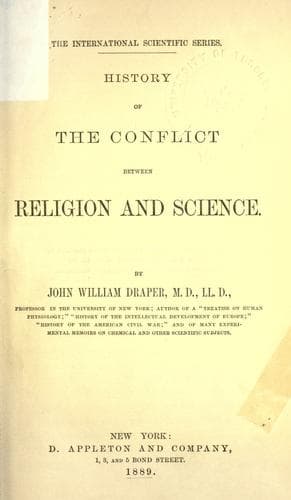
History of the Conflict Between Religion and ScienceDraper, John William
Religion
History of the Conflict Between Religion and Science
Draper, John William
Religion and science -- History
To remove the stagnation of centuries front European life, to vivify
suddenly what had hitherto been an inert mass, to impart to it
individualism, was to bring it into conflict with the influences
that had been oppressing it. All through the fourteenth and fifteenth
centuries uneasy strugglings gave a premonition of what was coming.
In the early part of the sixteenth (1517), the battle was joined.
Individualism found its embodiment in a sturdy German monk, and
therefore, perhaps necessarily, asserted its rights under theological
forms. There were some preliminary skirmishes about indulgences and
other minor matters, but very soon the real cause of dispute came
plainly into view. Martin Luther refused to think as he was ordered to
do by his ecclesiastical superiors at Rome; he asserted that he had an
inalienable right to interpret the Bible for himself.
At her first glance, Rome saw nothing in Martin Luther but a vulgar,
insubordinate, quarrelsome monk. Could the Inquisition have laid hold of
him, it would have speedily disposed of his affair; but, as the conflict
went on, it was discovered that Martin was not standing alone. Many
thousands of men, as resolute as himself, were coming up to his support;
and, while he carried on the combat with writings and words, they made
good his propositions with the sword.
THE REFORMATION. The vilification which was poured on Luther and his
doings was so bitter as to be ludicrous. It was declared that his father
was not his mother's husband, but an impish incubus, who had deluded
her; that, after ten years' struggling with his conscience, he had
become an atheist; that he denied the immortality of the soul; that
he had composed hymns in honor of drunkenness, a vice to which he
was unceasingly addicted; that he blasphemed the Holy Scriptures, and
particularly Moses; that he did not believe a word of what he preached;
that he had called the Epistle of St. James a thing of straw; and, above
all, that the Reformation was no work of his, but, in reality, was due
to a certain astrological position of the stars. It was, however, a
vulgar saying among the Roman ecclesiastics that Erasmus laid the egg of
the Reformation, and Luther hatched it.
Public-domain text, read in full here on John Shaqi.
Reviews
Reviews
No reviews yet
Be the first to share your thoughts on this work.
Elsewhere in the archive
Join the Discussion
Join the discussion
Sign in to leave a comment or review.
Sign InorCreate an account