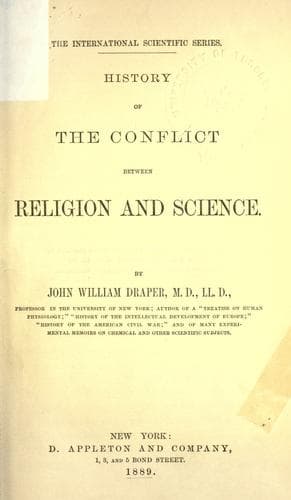
History of the Conflict Between Religion and ScienceDraper, John William
Religion
History of the Conflict Between Religion and Science
Draper, John William
Religion and science -- History
Rome at first made the mistake of supposing that this was nothing more
than a casual outbreak; she failed to discern that it was, in fact, the
culmination of an internal movement which for two centuries had been
going on in Europe, and which had been hourly gathering force; that,
had there been nothing else, the existence of three popes--three
obediences--would have compelled men to think, to deliberate, to
conclude for themselves. The Councils of Constance and Basle taught them
that there was a higher power than the popes. The long and bloody wars
that ensued were closed by the Peace of Westphalia; and then it was
found that Central and Northern Europe had cast off the intellectual
tyranny of Rome, that individualism had carried its point, and had
established the right of every man to think for himself.
DECOMPOSITION OF PROTESTANTISM. But it was impossible that the
establishment of this right of private judgment should end with the
rejection of Catholicism. Early in the movement some of the most
distinguished men, such as Erasmus, who had been among its first
promoters, abandoned it. They perceived that many of the Reformers
entertained a bitter dislike of learning, and they were afraid of
being brought under bigoted caprice. The Protestant party, having thus
established its existence by dissent and separation, must, in its turn,
submit to the operation of the same principles. A decomposition into
many subordinate sects was inevitable. And these, now that they had no
longer any thing to fear from their great Italian adversary, commenced
partisan warfares on each other. As, in different countries, first one
and then another sect rose to power, it stained itself with cruelties
perpetrated upon its competitors. The mortal retaliations that had
ensued, when, in the chances of the times, the oppressed got the better
of their oppressors, convinced the contending sectarians that they must
concede to their competitors what they claimed for themselves; and thus,
from their broils and their crimes, the great principle of toleration
extricated itself. But toleration is only an intermediate stage; and,
as the intellectual decomposition of Protestantism keeps going on, that
transitional condition will lead to a higher and nobler state--the hope
of philosophy in all past ages of the world--a social state in which
there shall be unfettered freedom for thought. Toleration, except
when extorted by fear, can only come from those who are capable of
entertaining and respecting other opinions than their own. It can
therefore only come from philosophy. History teaches us only too plainly
that fanaticism is stimulated by religion, and neutralized or eradicated
by philosophy.
Public-domain text, read in full here on John Shaqi.
Reviews
Reviews
No reviews yet
Be the first to share your thoughts on this work.
Elsewhere in the archive
Join the Discussion
Join the discussion
Sign in to leave a comment or review.
Sign InorCreate an account