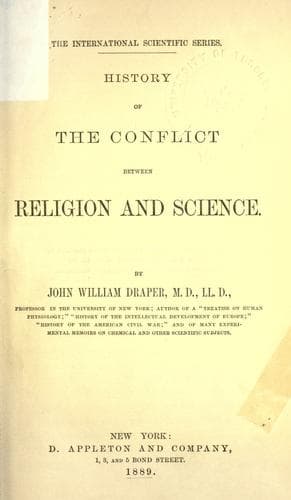
History of the Conflict Between Religion and ScienceDraper, John William
Religion
History of the Conflict Between Religion and Science
Draper, John William
Religion and science -- History
TOLERATION. The avowed object of the Reformation was, to remove from
Christianity the pagan ideas and pagan rites engrafted upon it by
Constantine and his successors, in their attempt to reconcile the Roman
Empire to it. The Protestants designed to bring it back to its primitive
purity; and hence, while restoring the ancient doctrines, they cast out
of it all such practices as the adoration of the Virgin Mary and
the invocation of saints. The Virgin Mary, we are assured by the
Evangelists, had accepted the duties of married life, and borne to her
husband several children. In the prevailing idolatry, she had ceased to
be regarded as the carpenter's wife; she had become the queen of heaven,
and the mother of God.
DA VINCI. The science of the Arabians followed the invading track of
their literature, which had come into Christendom by two routes--the
south of France, and Sicily. Favored by the exile of the popes to
Avignon, and by the Great Schism, it made good its foothold in Upper
Italy. The Aristotelian or Inductive philosophy, clad in the Saracenic
costume that Averroes had given it, made many secret and not a few open
friends. It found many minds eager to receive and able to appreciate
it. Among these were Leonardo da Vinci, who proclaimed the fundamental
principle that experiment and observation are the only reliable
foundations of reasoning in science, that experiment is the only
trustworthy interpreter of Nature, and is essential to the ascertainment
of laws. He showed that the action of two perpendicular forces upon a
point is the same as that denoted by the diagonal of a rectangle, of
which they represent the sides. From this the passage to the proposition
of oblique forces was very easy. This proposition was rediscovered by
Stevinus, a century later, and applied by him to the explanation of the
mechanical powers. Da Vinci gave a clear exposition of the theory of
forces applied obliquely on a lever, discovered the laws of friction
subsequently demonstrated by Amontons, and understood the principle of
virtual velocities. He treated of the conditions of descent of bodies
along inclined planes and circular arcs, invented the camera-obscura,
discussed correctly several physiological problems, and foreshadowed
some of the great conclusions of modern geology, such as the nature
of fossil remains, and the elevation of continents. He explained the
earth-light reflected by the moon. With surprising versatility of genius
he excelled as a sculptor, architect, engineer; was thoroughly versed in
the astronomy, anatomy, and chemistry of his times. In painting, he
was the rival of Michel Angelo; in a competition between them, he was
considered to have established his superiority. His "Last Supper," on
the wall of the refectory of the Dominican convent of Sta. Maria delle
Grazie, is well known, from the numerous engravings and copies that have
been made of it.
Public-domain text, read in full here on John Shaqi.
Reviews
Reviews
No reviews yet
Be the first to share your thoughts on this work.
Elsewhere in the archive
Join the Discussion
Join the discussion
Sign in to leave a comment or review.
Sign InorCreate an account