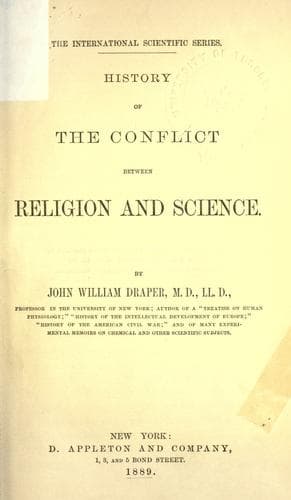
History of the Conflict Between Religion and ScienceDraper, John William
Religion
History of the Conflict Between Religion and Science
Draper, John William
Religion and science -- History
Its earliest application was in such operations as pumping, wherein mere
force is required. Soon, however, it vindicated its delicacy of touch
in the industrial arts of spinning and weaving. It created vast
manufacturing establishments, and supplied clothing for the world. It
changed the industry of nations.
In its application, first to the navigation of rivers, and then to the
navigation of the ocean, it more than quadrupled the speed that had
heretofore been attained. Instead of forty days being requisite for
the passage, the Atlantic might now be crossed in eight. But, in land
transportation, its power was most strikingly displayed. The admirable
invention of the locomotive enabled men to travel farther in less than
an hour than they formerly could have done in more than a day.
The locomotive has not only enlarged the field of human activity, but,
by diminishing space, it has increased the capabilities of human life.
In the swift transportation of manufactured goods and agricultural
products, it has become a most efficient incentive to human industry
The perfection of ocean steam-navigation was greatly promoted by the
invention of the chronometer, which rendered it possible to find
with accuracy the place of a ship at sea. The great drawback on the
advancement of science in the Alexandrian School was the want of an
instrument for the measurement of time, and one for the measurement of
temperature--the chronometer and the thermometer; indeed, the invention
of the latter is essential to that of the former. Clepsydras, or
water-clocks, had been tried, but they were deficient in accuracy. Of
one of them, ornamented with the signs of the zodiac, and destroyed by
certain primitive Christians, St. Polycarp significantly remarked, "In
all these monstrous demons is seen an art hostile to God." Not until
about 1680 did the chronometer begin to approach accuracy. Hooke, the
contemporary of Newton, gave it the balance-wheel, with the spiral
spring, and various escapements in succession were devised, such as the
anchor, the dead-beat, the duplex, the remontoir. Provisions for the
variation of temperature were introduced. It was brought to perfection
eventually by Harrison and Arnold, in their hands becoming an accurate
measure of the flight of time. To the invention of the chronometer
must be added that of the reflecting sextant by Godfrey. This permitted
astronomical observations to be made, notwithstanding the motion of a
ship.
Improvements in ocean navigation are exercising a powerful influence on
the distribution of mankind. They are increasing the amount and altering
the character of colonization.
Public-domain text, read in full here on John Shaqi.
Reviews
Reviews
No reviews yet
Be the first to share your thoughts on this work.
Elsewhere in the archive
Join the Discussion
Join the discussion
Sign in to leave a comment or review.
Sign InorCreate an account