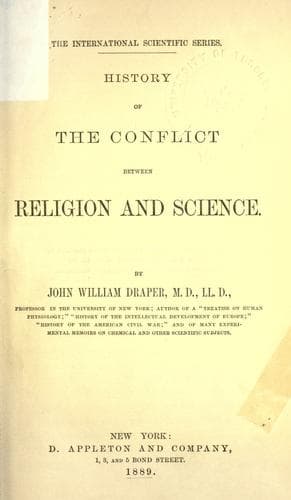
History of the Conflict Between Religion and ScienceDraper, John William
Religion
History of the Conflict Between Religion and Science
Draper, John William
Religion and science -- History
The views of the Oriental Churches were, for the most part, unfavorable.
They affirmed that they saw a desire in the Roman pontiff to set himself
up as the head of Christianity, whereas they recognized the Lord Jesus
Christ alone as the head of the Church. They believed that the Council
would only lead to new quarrels and scandals. The sentiment of these
venerable Churches is well shown by the incident that, when, in
1867, the Nestorian Patriarch Simeon had been invited by the Chaldean
Patriarch to return to Roman Catholic unity, he, in his reply, showed
that there was no prospect for harmonious action between the East and
the West: "You invite me to kiss humbly the slipper of the Bishop of
Rome; but is he not, in every respect, a man like yourself--is his
dignity superior to yours? We will never permit to be introduced into
our holy temples of worship images and statues, which are nothing but
abominable and impure idols. What! shall we attribute to Almighty God a
mother, as you dare to do? Away from us, such blasphemy!"
EXPECTATIONS OF THE PAPACY. Eventually, the patriarchs, archbishops, and
bishops, from all regions of the world, who took part in this Council,
were seven hundred and four.
Rome had seen very plainly that Science was not only rapidly undermining
the dogmas of the papacy, but was gathering great political power. She
recognized that all over Europe there was a fast-spreading secession
among persons of education, and that its true focus was North Germany.
She looked, therefore, with deep interest on the Prusso-Austrian War,
giving to Austria whatever encouragement she could. The battle of Sadowa
was a bitter disappointment to her.
With satisfaction again she looked upon the breaking out of the
Franco-Prussian War, not doubting that its issue would be favorable to
France, and therefore favorable to her. Here, again, she was doomed to
disappointment at Sedan.
Having now no further hope, for many years to come, from external war,
she resolved to see what could be done by internal insurrection, and the
present movement in the German Empire is the result of her machinations.
Had Austria or had France succeeded, Protestantism would have been
overthrown along with Prussia.
But, while these military movements were being carried on, a movement of
a different, an intellectual kind, was engaged in. Its principle was, to
restore the worn-out mediaeval doctrines and practices, carrying them to
an extreme, no matter what the consequences might be.
ENCYCLICAL LETTER AND SYLLABUS. Not only was it asserted that the papacy
has a divine right to participate in the government of all countries,
coordinately with their temporal authorities, but that the supremacy of
Rome in this matter must be recognized; and that in any question between
them the temporal authority must conform itself to her order.
Public-domain text, read in full here on John Shaqi.
Reviews
Reviews
No reviews yet
Be the first to share your thoughts on this work.
Elsewhere in the archive
Join the Discussion
Join the discussion
Sign in to leave a comment or review.
Sign InorCreate an account