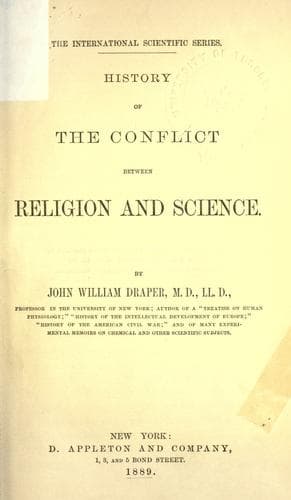
History of the Conflict Between Religion and ScienceDraper, John William
Religion
History of the Conflict Between Religion and Science
Draper, John William
Religion and science -- History
And, since the endangering of her position had been mainly brought about
by the progress of science, she presumed to define its boundaries, and
prescribe limits to its authority. Still more, she undertook to denounce
modern civilization.
These measures were contemplated soon after the return of his Holiness
from Gaeta in 1848, and were undertaken by the advice of the Jesuits,
who, lingering in the hope that God would work the impossible, supposed
that the papacy, in its old age, might be reinvigorated. The organ of
the Curia proclaimed the absolute independence of the Church as regards
the state; the dependence of the bishops on the pope; of the diocesan
clergy on the bishops; the obligation of the Protestants to abandon
their atheism, and return to the fold; the absolute condemnation of all
kinds of toleration. In December, 1854, in an assembly of bishops, the
pope had proclaimed the dogma of the immaculate conception. Ten years
subsequently he put forth the celebrated Encyclical Letter and the
Syllabus.
The Encyclical Letter is dated December 8, 1864. It was drawn up by
learned ecclesiastics, and subsequently debated at the Congregation of
the Holy Office, then forwarded to prelates, and finally gone over by
the pope and cardinals.
ENCYCLICAL LETTER AND SYLLABUS. Many of the clergy objected to its
condemnation of modern civilization. Some of the cardinals were
reluctant to concur in it. The Catholic press accepted it, not, however,
without misgivings and regrets. The Protestant governments put no
obstacle in its way; the Catholic were embarrassed by it. France allowed
the publication only of that portion proclaiming the jubilee; Austria
and Italy permitted its introduction, but withheld their approval.
The political press and legislatures of Catholic countries gave it an
unfavorable reception. Many deplored it as likely to widen the breach
between the Church and modern society. The Italian press regarded it as
determining a war, without truce or armistice, between the papacy and
modern civilization. Even in Spain there were journals that regretted
"the obstinacy and blindness of the court of Rome, in branding and
condemning modern civilization."
Public-domain text, read in full here on John Shaqi.
Reviews
Reviews
No reviews yet
Be the first to share your thoughts on this work.
Elsewhere in the archive
Join the Discussion
Join the discussion
Sign in to leave a comment or review.
Sign InorCreate an account