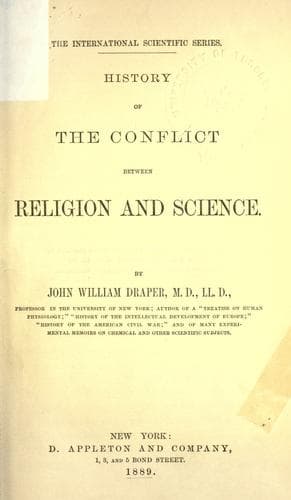
History of the Conflict Between Religion and ScienceDraper, John William
Religion
History of the Conflict Between Religion and Science
Draper, John William
Religion and science -- History
THE VATICAN COUNCIL. On the appointed day, the Council opened. Its
objects were, to translate the Syllabus into practice, to establish the
dogma of papal infallibility, and define the relations of religion to
science. Every preparation had been made that the points determined on
should be carried. The bishops were informed that they were coming to
Rome not to deliberate, but to sanction decrees previously made by
an infallible pope. No idea was entertained of any such thing as
free discussion. The minutes of the meetings were not permitted to be
inspected; the prelates of the opposition were hardly allowed to speak.
On January 22, 1870, a petition, requesting that the infallibility of
the pope should be defined, was presented; an opposition petition of the
minority was offered. Hereupon, the deliberations of the minority were
forbidden, and their publications prohibited. And, though the Curia had
provided a compact majority, it was found expedient to issue an order
that to carry any proposition it was not necessary that the vote should
be near unanimity, a simple majority sufficed. The remonstrances of the
minority were altogether unheeded.
As the Council pressed forward to its object, foreign authorities
became alarmed at its reckless determination. A petition drawn up by the
Archbishop of Vienna, and signed by several cardinals and archbishops,
entreated his Holiness not to submit the dogma of infallibility for
consideration, "because the Church has to sustain at present a struggle
unknown in former times, against men who oppose religion itself as
an institution baneful to human nature, and that it is inopportune
to impose upon Catholic nations, led into temptation by so many
machinations, more dogmas than the Council of Trent proclaimed." It
added that "the definition demanded would furnish fresh arms to
the enemies of religion, to excite against the Catholic Church the
resentment of men avowedly the best." The Austrian prime-minister
addressed a protest to the papal government, warning it against any
steps that might lead to encroachments on the rights of Austria. The
French Government also addressed a note, suggesting that a French bishop
should explain to the Council the condition and the rights of France. To
this the papal government replied that a bishop could not reconcile the
double duties of an ambassador and a Father of the Council. Hereupon,
the French Government, in a very respectful note, remarked that,
to prevent ultra opinions from becoming dogmas, it reckoned on the
moderation of the bishops, and the prudence of the Holy Father; and,
to defend its civil and political laws against the encroachments of the
theocracy, it had counted on public reason and the patriotism of French
Catholics. In these remonstrances the North-German Confederation joined,
seriously pressing them on the consideration of the papal government.
Public-domain text, read in full here on John Shaqi.
Reviews
Reviews
No reviews yet
Be the first to share your thoughts on this work.
Elsewhere in the archive
Join the Discussion
Join the discussion
Sign in to leave a comment or review.
Sign InorCreate an account