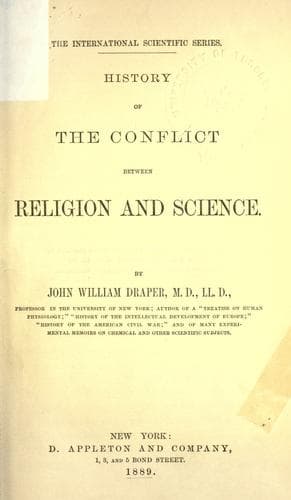
History of the Conflict Between Religion and ScienceDraper, John William
Religion
History of the Conflict Between Religion and Science
Draper, John William
Religion and science -- History
On April 23d, Von Arnim, the Prussian embassador, united with Daru, the
French minister, in suggesting to the Curia the inexpediency of reviving
mediaeval ideas. The minority bishops, thus encouraged, demanded now
that the relations of the spiritual to the secular power should be
determined before the pope's infallibility was discussed, and that it
should be settled whether Christ had conferred on St. Peter and his
successors a power over kings and emperors.
INFALLIBILITY OF THE POPE. No regard was paid to this, not even delay
was consented to. The Jesuits, who were at the bottom of the movement,
carried their measures through the packed assembly with a high hand. The
Council omitted no device to screen itself from popular criticism. Its
proceedings were conducted with the utmost secrecy; all who took part in
them were bound by a solemn oath to observe silence.
On July 13th, the votes were taken. Of 601 votes, 451 were affirmative.
Under the majority rule, the measure was pronounced carried, and, five
days subsequently, the pope proclaimed the dogma of his infallibility.
It has often been remarked that this was the day on which the French
declared war against Prussia. Eight days afterward the French troops
were withdrawn from Rome. Perhaps both the statesman and the philosopher
will admit that an infallible pope would be a great harmonizing element,
if only common-sense could acknowledge him.
Hereupon, the King of Italy addressed an autograph letter to the pope,
setting forth in very respectful terms the necessity that his troops
should advance and occupy positions "indispensable to the security of
his Holiness, and the maintenance of order;" that, while satisfying
the national aspirations, the chief of Catholicity, surrounded by the
devotion of the Italian populations, "might preserve on the banks of the
Tiber a glorious seat, independent of all human sovereignty."
To this his Holiness replied in a brief and caustic letter: "I give
thanks to God, who has permitted your majesty to fill the last days of
my life with bitterness. For the rest, I cannot grant certain requests,
nor conform with certain principles contained in your letter. Again, I
call upon God, and into his hands commit my cause, which is his cause.
I pray God to grant your majesty many graces, to free you from dangers,
and to dispense to you his mercy which you so much need."
Public-domain text, read in full here on John Shaqi.
Reviews
Reviews
No reviews yet
Be the first to share your thoughts on this work.
Elsewhere in the archive
Join the Discussion
Join the discussion
Sign in to leave a comment or review.
Sign InorCreate an account