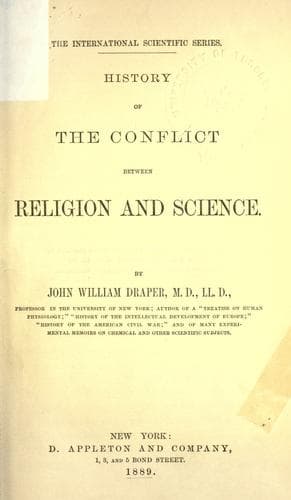
History of the Conflict Between Religion and ScienceDraper, John William
Religion
History of the Conflict Between Religion and Science
Draper, John William
Religion and science -- History
THE CHURCH A POLITICAL POWER. The Jesuit party was extending and
strengthening an organization all over Germany, based on the principle
that state legislation in ecclesiastical matters is not binding. Here
was an act of open insurrection. Could the government allow itself to be
intimidated? The Bishop of Ermeland declared that he would not obey the
laws of the state if they touched the Church. The government stopped the
payment of his salary; and, perceiving that there could be no peace
so long as the Jesuits were permitted to remain in the country, their
expulsion was resolved on, and carried into effect. At the close of
1872 his Holiness delivered an allocution, in which he touched on the
"persecution of the Church in the German Empire," and asserted that the
Church alone has a right to fix the limits between its domain and that
of the state--a dangerous and inadmissible principle, since under the
term morals the Church comprises all the relations of men to each other,
and asserts that whatever does not assist her oppresses her. Hereupon, a
few days subsequently (January 9, 1873), four laws were brought forward
by the government: 1. Regulating the means by which a person might
sever his connection with the Church; 2. Restricting the Church in the
exercise of ecclesiastical punishments; 3. Regulating the ecclesiastical
power of discipline, forbidding bodily chastisement, regulating fines
and banishments granting the privilege of an appeal to the Royal Court
of Justice for Ecclesiastical Affairs, the decision of which is final;
4. Ordaining the preliminary education and appointment of priests. They
must have had a satisfactory education, passed a public examination
conducted by the state, and have a knowledge of philosophy, history,
and German literature. Institutions refusing to be superintended by the
state are to be closed.
These laws demonstrate that Germany is resolved that she will no longer
be dictated to nor embarrassed by a few Italian noble families; that she
will be master of her own house. She sees in the conflict, not an affair
of religion or of conscience, but a struggle between the sovereignty
of state legislation and the sovereignty of the Church. She treats the
papacy not in the aspect of a religious, but of a political power, and
is resolved that the declaration of the Prussian Constitution shall be
maintained, that "the exercise of religious freedom must not interfere
with the duties of a citizen toward the community and the state."
Public-domain text, read in full here on John Shaqi.
Reviews
Reviews
No reviews yet
Be the first to share your thoughts on this work.
Elsewhere in the archive
Join the Discussion
Join the discussion
Sign in to leave a comment or review.
Sign InorCreate an account