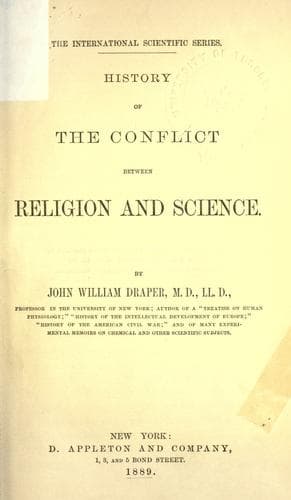
History of the Conflict Between Religion and ScienceDraper, John William
Religion
History of the Conflict Between Religion and Science
Draper, John William
Religion and science -- History
The Prussian Government had earnestly desired to remain on amicable
terms with the papacy; it had no wish to enter on a theological quarrel;
but gradually the conviction was forced upon it that the question was
not a religious but a political one--whether the power of the state
should be used against the state. A teacher in a gymnasium had been
excommunicated; the government, on being required to dismiss him,
refused. The Church authorities denounced this as an attack upon faith.
The emperor sustained his minister. The organ of the infallible party
threatened the emperor with the opposition of all good Catholics, and
told him that, in a contention with the pope, systems of government can
and must change. It was now plain to every one that the question had
become, "Who is to be master in the state, the government or the Roman
Church? It is plainly impossible for men to live under two governments,
one of which declares to be wrong what the other commands. If the
government will not submit to the Roman Church, the two are enemies." A
conflict was thus forced upon Prussia by Rome--a conflict in which the
latter, impelled by her antagonism to modern civilization, is clearly
the aggressor.
ACTION OF THE PRUSSIAN GOVERNMENT. The government, now recognizing its
antagonist, defended itself by abolishing the Catholic department in
the ministry of Public Worship. This was about midsummer, 1871. In
the following November the Imperial Parliament passed a law that
ecclesiastics abusing their office, to the disturbance of the public
peace, should be criminally punished. And, guided by the principle that
the future belongs to him to whom the school belongs, a movement arose
for the purpose of separating the schools from the Church.
Public-domain text, read in full here on John Shaqi.
Reviews
Reviews
No reviews yet
Be the first to share your thoughts on this work.
Elsewhere in the archive
Join the Discussion
Join the discussion
Sign in to leave a comment or review.
Sign InorCreate an account