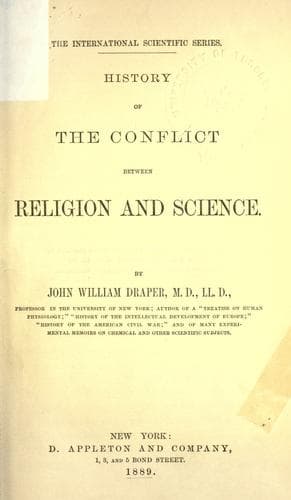
History of the Conflict Between Religion and ScienceDraper, John William
Religion
History of the Conflict Between Religion and Science
Draper, John William
Religion and science -- History
"For the doctrine of faith revealed by God has not been proposed, like
some philosophical discovery, to be made perfect by human ingenuity, but
it has been delivered to the spouse of Christ as a divine deposit, to be
faithfully guarded and unerringly set forth. Hence, all tenets of holy
faith are to be explained always according to the sense and meaning of
the Church; nor is it ever lawful to depart therefrom under pretense or
color of a more enlightened explanation. Therefore, as generations and
centuries roll on, let the understanding, knowledge, and wisdom of each
and every one, of individuals and of the whole Church, grow apace and
increase exceedingly, yet only in its kind; that is to say retaining
pure and inviolate the sense and meaning and belief of the same
doctrine."
Among other canons the following were promulgated.
"Let him be anathema--
"Who denies the one true God, Creator and Lord of all things, visible
and invisible.
"Who unblushingly affirms that, besides matter, nothing else exists.
"Who says that the substance or essence of God, and of all things, is
one and the same.
"Who says that finite things, both corporeal and spiritual, or at least
spiritual things, are emanations of the divine substance; or that the
divine essence, by manifestation or development of itself, becomes all
things.
"Who does not acknowledge that the world and all things which it
contains were produced by God out of nothing.
"Who shall say that man can and ought to, of his own efforts, by means
of, constant progress, arrive, at last, at the possession of all truth
and goodness.
"Who shall refuse to receive, for sacred and canonical, the books of
Holy Scripture in their integrity, with all their parts, according as
they were enumerated by the holy Council of Trent, or shall deny that
they are Inspired by God.
"Who shall say that human reason is in such wise independent, that faith
cannot be demanded of it by God.
"Who shall say that divine revelation cannot be rendered credible by
external evidences.
"Who shall say that no miracles can be wrought, or that they can never
be known with certainty, and that the divine origin of Christianity
cannot be proved by them.
"Who shall say that divine revelation includes no mysteries, but that
all the dogmas of faith may be understood and demonstrated by reason
duly cultivated.
"Who shall say that human sciences ought to be pursued in such a spirit
of freedom that one may be allowed to hold as true their assertions,
even when opposed to revealed doctrine.
"Who shall say that it may at any time come to pass, in the progress
of science, that the doctrines set forth by the Church must be taken in
another sense than that in which the Church has ever received and yet
receives them."
Public-domain text, read in full here on John Shaqi.
Reviews
Reviews
No reviews yet
Be the first to share your thoughts on this work.
Elsewhere in the archive
Join the Discussion
Join the discussion
Sign in to leave a comment or review.
Sign InorCreate an account