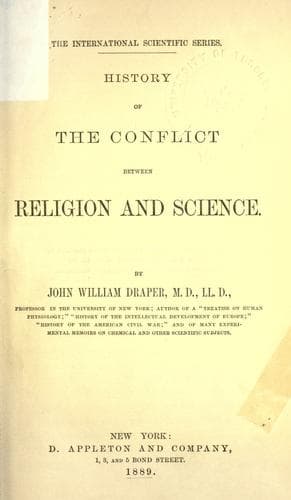
History of the Conflict Between Religion and ScienceDraper, John William
Religion
History of the Conflict Between Religion and Science
Draper, John William
Religion and science -- History
THE EVANGELICAL ALLIANCE. The extraordinary and, indeed, it may be said,
arrogant assumptions contained in these decisions were far from being
received with satisfaction by educated Catholics. On the part of the
German universities there was resistance; and, when, at the close of the
year, the decrees of the Vatican Council were generally acquiesced in,
it was not through conviction of their truth, but through a disciplinary
sense of obedience.
By many of the most pious Catholics the entire movement and the results
to which it had led were looked upon with the sincerest sorrow. Pere
Hyacinthe, in a letter to the superior of his order, says: "I protest
against the divorce, as impious as it is insensate, sought to be
effected between the Church, which is our eternal mother, and the
society of the nineteenth century, of which we are the temporal
children, and toward which we have also duties and regards. It is my
most profound conviction that, if France in particular, and the Latin
race in general, are given up to social, moral, and religious anarchy,
the principal cause undoubtedly is not Catholicism itself, but the
manner in which Catholicism has for a long time been understood and
practised."
Notwithstanding his infallibility, which implies omniscience, his
Holiness did not foresee the issue of the Franco-Prussian War. Had the
prophetical talent been vouchsafed to him, he would have detected the
inopportuneness of the acts of his Council. His request to the King of
Prussia for military aid to support his temporal power was denied. The
excommunicated King of Italy, as we have seen, took possession of Rome.
A bitter papal encyclical, strangely contrasting with the courteous
politeness of modern state-papers, was issued, November 1, 1870,
denouncing the acts of the Piedmontese court, "which had followed the
counsel of the sects of perdition." In this his Holiness declares that
he is in captivity, and that he will have no agreement with Belial. He
pronounces the greater excommunication, with censures and penalties,
against his antagonists, and prays for "the intercession of the
immaculate Virgin Mary, mother of God, and that of the blessed apostles
Peter and Paul."
Public-domain text, read in full here on John Shaqi.
Reviews
Reviews
No reviews yet
Be the first to share your thoughts on this work.
Elsewhere in the archive
Join the Discussion
Join the discussion
Sign in to leave a comment or review.
Sign InorCreate an account