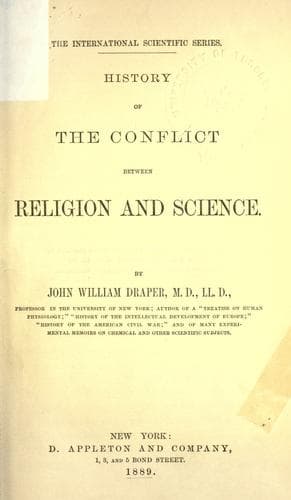
History of the Conflict Between Religion and ScienceDraper, John William
Religion
History of the Conflict Between Religion and Science
Draper, John William
Religion and science -- History
In like manner they dispose of the doctrines of Evolution and
Development, bluntly insisting that the Church believes in distinct
creative acts. The doctrine that every living form is derived from some
preceding form is scientifically in a much more advanced position than
that concerning Force, and probably may be considered as established,
whatever may become of the additions with which it has recently been
overlaid.
In her condemnation of the Reformation, the Church carries into effect
her ideas of the subordination of reason to faith. In her eyes the
Reformation is an impious heresy, leading to the abyss of pantheism,
materialism, and atheism, and tending to overthrow the very foundations
of human society. She therefore would restrain those "restless spirits"
who, following Luther, have upheld the "right of every man to interpret
the Scriptures for himself." She asserts that it is a wicked error to
admit Protestants to equal political privileges with Catholics, and that
to coerce them and suppress them is a sacred duty; that it is abominable
to permit them to establish educational institutions. Gregory XVI.
denounced freedom of conscience as an insane folly, and the freedom of
the press a pestilent error, which cannot be sufficiently detested.
But how is it possible to recognize an inspired and infallible oracle on
the Tiber, when it is remembered that again and again successive popes
have contradicted each other; that popes have denounced councils, and
councils have denounced popes; that the Bible of Sixtus V. had so many
admitted errors--nearly two thousand--that its own authors had to recall
it? How is it possible for the children of the Church to regard as
"delusive errors" the globular form of the earth, her position as a
planet in the solar system, her rotation on her axis, her movement round
the sun? How can they deny that there are antipodes, and other worlds
than ours? How can they believe that the world was made out of nothing,
completed in a week, finished just as we see it now; that it has
undergone no change, but that its parts have worked so indifferently as
to require incessant interventions?
Public-domain text, read in full here on John Shaqi.
Reviews
Reviews
No reviews yet
Be the first to share your thoughts on this work.
Elsewhere in the archive
Join the Discussion
Join the discussion
Sign in to leave a comment or review.
Sign InorCreate an account