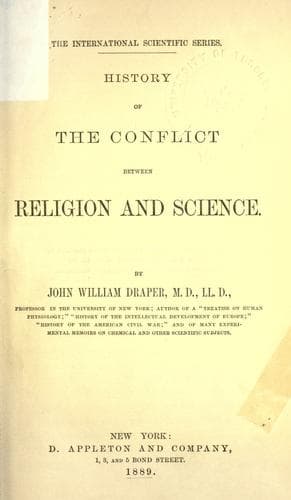
History of the Conflict Between Religion and ScienceDraper, John William
Religion
History of the Conflict Between Religion and Science
Draper, John William
Religion and science -- History
But has not the order of civilization in all parts of the world been the
same? Does not the growth of society resemble individual growth? Do not
both exhibit to us phases of youth, of maturity, of decrepitude? To
a person who has carefully considered the progressive civilization of
groups of men in regions of the earth far apart, who has observed the
identical forms under which that advancing civilization has manifested
itself, is it not clear that the procedure is determined by law? The
religious ideas of the Incas of Peru and the emperors of Mexico, and the
ceremonials of their court-life, were the same as those in Europe--the
same as those in Asia. The current of thought had been the same. A swarm
of bees carried to some distant land will build its combs and regulate
its social institutions as other unknown swarms would do, and so with
separated and disconnected swarms of men. So invariable is this sequence
of thought and act, that there are philosophers who, transferring the
past example offered by Asiatic history to the case of Europe, would
not hesitate to sustain the proposition--given a bishop of Rome and some
centuries, and you will have an infallible pope: given an infallible
pope and a little more time, and you will have Llamaism--Llamaism to
which Asia has long, ago attained.
As to the origin of corporeal and spiritual things, the Dogmatic
Constitution adds a solemn emphasis to its declarations, by
anathematizing all those who hold the doctrine of emanation, or who
believe that visible Nature is only a manifestation of the Divine
Essence. In this its authors had a task of no ordinary difficulty before
them. They must encounter those formidable ideas, whether old or new,
which in our times are so strongly forcing themselves on thoughtful men.
The doctrine of the conservation and correlation of Force yields as its
logical issue the time-worn Oriental emanation theory; the doctrines of
Evolution and Development strike at that of successive creative acts.
The former rests on the fundamental principle that the quantity of
force in the universe is invariable. Though that quantity can neither be
increased nor diminished, the forms under which Force expresses itself
may be transmuted into each other. As yet this doctrine has not received
complete scientific demonstration, but so numerous and so cogent are the
arguments adduced in its behalf, that it stands in an imposing, almost
in an authoritative attitude. Now, the Asiatic theory of emanation and
absorption is seen to be in harmony with this grand idea. It does not
hold that, at the conception of a human being, a soul is created by
God out of nothing and given to it, but that a portion of the already
existing, the divine, the universal intelligence, is imparted, and, when
life is over, this returns to and is absorbed in the general source from
which it originally came. The authors of the Constitution forbid these
ideas to be held, under pain of eternal punishment.
Public-domain text, read in full here on John Shaqi.
Reviews
Reviews
No reviews yet
Be the first to share your thoughts on this work.
Elsewhere in the archive
Join the Discussion
Join the discussion
Sign in to leave a comment or review.
Sign InorCreate an account