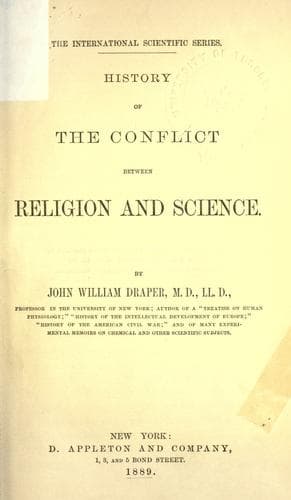
History of the Conflict Between Religion and ScienceDraper, John William
Religion
History of the Conflict Between Religion and Science
Draper, John William
Religion and science -- History
Is it at all surprising that the number of those who hold the opinions
of the Church in light esteem should so rapidly increase? How can that
be received as a trustworthy guide in the invisible, which falls into so
many errors in the visible? How can that give confidence in the moral,
the spiritual, which has so signally failed in the physical? It is not
possible to dispose of these conflicting facts as "empty shadows," "vain
devices," "fictions coming from knowledge falsely so called," "errors
wearing the deceitful appearance of truth," as the Church stigmatizes
them. On the contrary, they are stern witnesses, bearing emphatic
and unimpeachable testimony against the ecclesiastical claim to
infallibility, and fastening a conviction of ignorance and blindness
upon her.
Convicted of so many errors, the papacy makes no attempt at explanation.
It ignores the whole matter Nay, more, relying on the efficacy
of audacity, though confronted by these facts, it lays claim to
infallibility.
SEPARATION OF CATHOLICISM AND CIVILIZATION. But, to the pontiff, no
other rights can be conceded than those he can establish at the bar of
Reason. He cannot claim infallibility in religious affairs, and
decline it in scientific. Infallibility embraces all things. It implies
omniscience. If it holds good for theology, it necessarily holds good
for science. How is it possible to coordinate the infallibility of the
papacy with the well-known errors into which it has fallen?
Does it not, then, become needful to reject the claim of the papacy
to the employment of coercion in the maintenance of its opinions; to
repudiate utterly the declaration that "the Inquisition is an urgent
necessity in view of the unbelief of the present age," and in the name
of human nature to protest loudly against the ferocity and terrorism of
that institution? Has not conscience inalienable rights?
An impassable and hourly-widening gulf intervenes between Catholicism
and the spirit of the age. Catholicism insists that blind faith is
superior to reason; that mysteries are of more importance than facts.
She claims to be the sole interpreter of Nature and revelation, the
supreme arbiter of knowledge; she summarily rejects all modern criticism
of the Scriptures, and orders the Bible to be accepted in accordance
with the views of the theologians of Trent; she openly avows her hatred
of free institutions and constitutional systems, and declares that those
are in damnable error who regard the reconciliation of the pope with
modern civilization as either possible or desirable.
Public-domain text, read in full here on John Shaqi.
Reviews
Reviews
No reviews yet
Be the first to share your thoughts on this work.
Elsewhere in the archive
Join the Discussion
Join the discussion
Sign in to leave a comment or review.
Sign InorCreate an account