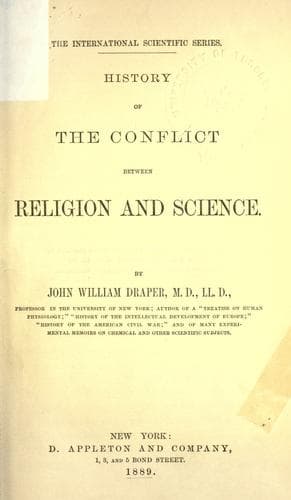
History of the Conflict Between Religion and ScienceDraper, John William
Religion
History of the Conflict Between Religion and Science
Draper, John William
Religion and science -- History
SCIENCE AND PROTESTANTISM. But the spirit of the age demands--is the
human intellect to be subordinated to the Tridentine Fathers, or to the
fancy of illiterate and uncritical persons who wrote in the earlier ages
of the Church? It sees no merit in blind faith, but rather distrusts it.
It looks forward to an improvement in the popular canon of credibility
for a decision between fact and fiction. It does not consider itself
bound to believe fables and falsehoods that have been invented for
ecclesiastical ends. It finds no argument in behalf of their truth, that
traditions and legends have been long-lived; in this respect, those of
the Church are greatly inferior to the fables of paganism. The longevity
of the Church itself is not due to divine protection or intervention,
but to the skill with which it has adapted its policy to existing
circumstances. If antiquity be the criterion of authenticity, the claims
of Buddhism must be respected; it has the superior warrant of many
centuries. There can be no defense of those deliberate falsifications of
history, that concealment of historical facts, of which the Church has
so often taken advantage. In these things the end does not justify the
means.
Then has it in truth come to this, that Roman Christianity and Science
are recognized by their respective adherents as being absolutely
incompatible; they cannot exist together; one must yield to the other;
mankind must make its choice--it cannot have both.
SCIENCE AND FAITH. While such is, perhaps, the issue as regards
Catholicism, a reconciliation of the Reformation with Science is not
only possible, but would easily take place, if the Protestant Churches
would only live up to the maxim taught by Luther, and established by so
many years of war. That maxim is, the right of private interpretation of
the Scriptures. It was the foundation of intellectual liberty. But, if
a personal interpretation of the book of Revelation is permissible,
how can it be denied in the case of the book of Nature? In the
misunderstandings that have taken place, we must ever bear in mind
the infirmities of men. The generations that immediately followed
the Reformation may perhaps be excused for not comprehending the full
significance of their cardinal principle, and for not on all occasions
carrying it into effect. When Calvin caused Servetus, to be burnt, he
was animated, not by the principles of the Reformation, but by those
of Catholicism, from which he had not been able to emancipate himself
completely. And when the clergy of influential Protestant confessions
have stigmatized the investigators of Nature as infidels and atheists,
the same may be said. For Catholicism to reconcile itself to Science,
there are formidable, perhaps insuperable obstacles in the way. For
Protestantism to achieve that great result there are not. In the one
case there is a bitter, a mortal animosity to be overcome; in the other,
a friendship, that misunderstandings have alienated, to be restored.
Public-domain text, read in full here on John Shaqi.
Reviews
Reviews
No reviews yet
Be the first to share your thoughts on this work.
Elsewhere in the archive
Join the Discussion
Join the discussion
Sign in to leave a comment or review.
Sign InorCreate an account