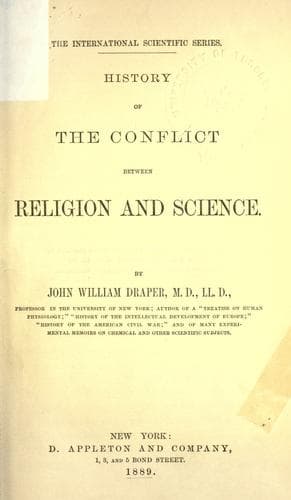
History of the Conflict Between Religion and ScienceDraper, John William
Religion
History of the Conflict Between Religion and Science
Draper, John William
Religion and science -- History
CIVILIZATION AND RELIGION. But, whatever may be the preparatory
incidents of that great impending intellectual crisis which Christendom
must soon inevitably witness, of this we may rest assured, that the
silent secession from the public faith, which in so ominous a manner
characterizes the present generation, will find at length political
expression. It is not without significance that France reenforces the
ultramontane tendencies of her lower population, by the promotion of
pilgrimages, the perpetration of miracles, the exhibition of celestial
apparitions. Constrained to do this by her destiny, she does it with
a blush. It is not without significance that Germany resolves to rid
herself of the incubus of a dual government, by the exclusion of the
Italian element, and to carry to its completion that Reformation which
three centuries ago she left unfinished. The time approaches when
men must take their choice between quiescent, immobile faith and
ever-advancing Science--faith, with its mediaeval consolations, Science,
which is incessantly scattering its material blessings in the pathway
of life, elevating the lot of man in this world, and unifying the
human race. Its triumphs are solid and enduring. But the glory which
Catholicism might gain from a conflict with material ideas is at the
best only like that of other celestial meteors when they touch the
atmosphere of the earth--transitory and useless.
Though Guizot's affirmation that the Church has always sided with
despotism is only too true, it must be remembered that in the policy
she follows there is much of political necessity. She is urged on by
the pressure of nineteen centuries. But, if the irresistible indicates
itself in her action, the inevitable manifests itself in her life. For
it is with the papacy as with a man. It has passed through the struggles
of infancy, it has displayed the energies of maturity, and, its work
completed, it must sink into the feebleness and querulousness of old
age. Its youth can never be renewed. The influence of its souvenirs
alone will remain. As pagan Rome threw her departing shadow over the
empire and tinctured all its thoughts, so Christian Rome casts her
parting shadow over Europe.
Public-domain text, read in full here on John Shaqi.
Reviews
Reviews
No reviews yet
Be the first to share your thoughts on this work.
Elsewhere in the archive
Join the Discussion
Join the discussion
Sign in to leave a comment or review.
Sign InorCreate an account