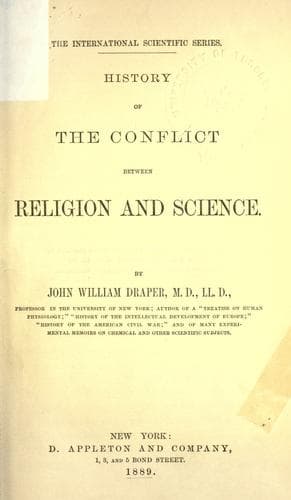
History of the Conflict Between Religion and ScienceDraper, John William
Religion
History of the Conflict Between Religion and Science
Draper, John William
Religion and science -- History
With the Alexandrian mathematicians and physicists must be classed
Archimedes, though he eventually resided in Sicily. Among his
mathematical works were two books on the Sphere and Cylinder, in
which he gave the demonstration that the solid content of a sphere is
two-thirds that of its circumscribing cylinder. So highly did he esteem
this, that he directed the diagram to be engraved on his tombstone. He
also treated of the quadrature of the circle and of the parabola; he
wrote on Conoids and Spheroids, and on the spiral that bears his name,
the genesis of which was suggested to him by his friend Conon the
Alexandrian. As a mathematician, Europe produced no equal to him for
nearly two thousand years. In physical science he laid the foundation
of hydrostatics; invented a method for the determination of specific
gravities; discussed the equilibrium of floating bodies; discovered the
true theory of the lever, and invented a screw, which still bears
his name, for raising the water of the Nile. To him also are to be
attributed the endless screw, and a peculiar form of burning-mirror, by
which, at the siege of Syracuse, it is said that he set the Roman fleet
on fire.
ERATOSTHENES--APOLLONIUS--HIPPARCHUS. Eratosthenes, who at one time had
charge of the library, was the author of many important works. Among
them may be mentioned his determination of the interval between
the tropics, and an attempt to ascertain the size of the earth. He
considered the articulation and expansion of continents, the position
of mountain-chains, the action of clouds, the geological submersion of
lands, the elevation of ancient sea-beds, the opening of the Dardanelles
and the straits of Gibraltar, and the relations of the Euxine Sea.
He composed a complete system of the earth, in three books--physical,
mathematical, historical--accompanied by a map of all the parts then
known. It is only of late years that the fragments remaining of his
"Chronicles of the Theban Kings" have been justly appreciated. For
many centuries they were thrown into discredit by the authority of our
existing absurd theological chronology.
Public-domain text, read in full here on John Shaqi.
Reviews
Reviews
No reviews yet
Be the first to share your thoughts on this work.
Join the Discussion
Join the discussion
Sign in to leave a comment or review.
Sign InorCreate an account