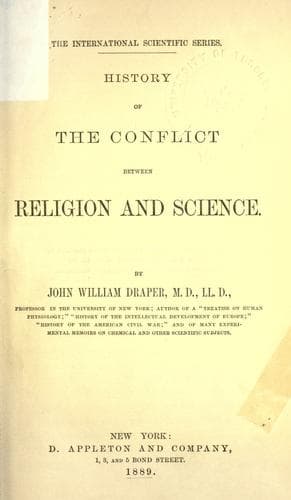
History of the Conflict Between Religion and ScienceDraper, John William
Religion
History of the Conflict Between Religion and Science
Draper, John William
Religion and science -- History
Of this presumptuous system, the strangest part was its logic, the
nature of its proofs. It relied upon miracle-evidence. A fact was
supposed to be demonstrated by an astounding illustration of something
else! An Arabian writer, referring to this, says: "If a conjurer should
say to me, 'Three are more than ten, and in proof of it I will change
this stick into a serpent,' I might be surprised at his legerdemain,
but I certainly should not admit his assertion." Yet, for more than
a thousand years, such was the accepted logic, and all over Europe
propositions equally absurd were accepted on equally ridiculous proof.
Since the party that had become dominant in the empire could not furnish
works capable of intellectual competition with those of the great pagan
authors, and since it was impossible for it to accept a position of
inferiority, there arose a political necessity for the discouragement,
and even persecution, of profane learning. The persecution of the
Platonists under Valentinian was due to that necessity. They were
accused of magic, and many of them were put to death. The profession
of philosophy had become dangerous--it was a state crime. In its stead
there arose a passion for the marvelous, a spirit of superstition. Egypt
exchanged the great men, who had made her Museum immortal, for bands of
solitary monks and sequestered virgins, with which she was overrun.
CHAPTER III.
CONFLICT RESPECTING THE DOCTRINE OF THE UNITY OF GOD.--THE
FIRST OR SOUTHERN REFORMATION.
The Egyptians insist on the introduction of the worship of
the Virgin Mary--They are resisted by Nestor, the Patriarch
of Constantinople, but eventually, through their influence
with the emperor, cause Nestor's exile and the dispersion of
his followers.
Prelude to the Southern Reformation--The Persian attack; its
moral effects.
The Arabian Reformation.--Mohammed is brought in contact
with the Nestorians--He adopts and extends their principles,
rejecting the worship of the Virgin, the doctrine of the
Trinity, and every thing in opposition to the unity of God.--
He extinguishes idolatry in Arabia, by force, and prepares
to make war on the Roman Empire.--His successors conquer
Syria, Egypt, Asia Minor, North Africa, Spain, and invade
France.
As the result of this conflict, the doctrine of the unity of
God was established in the greater part of the Roman Empire--
The cultivation of science was restored, and Christendom
lost many of her most illustrious capitals, as Alexandria,
Carthage, and, above all, Jerusalem.
Public-domain text, read in full here on John Shaqi.
Reviews
Reviews
No reviews yet
Be the first to share your thoughts on this work.
Elsewhere in the archive
Join the Discussion
Join the discussion
Sign in to leave a comment or review.
Sign InorCreate an account