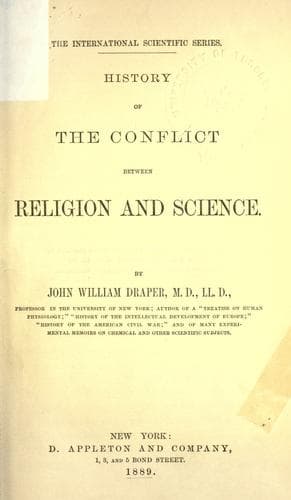
History of the Conflict Between Religion and ScienceDraper, John William
Religion
History of the Conflict Between Religion and Science
Draper, John William
Religion and science -- History
EGYPTIAN DOCTRINES. In the paganization of religion, now in all
directions taking place, it became the interest of every bishop to
procure an adoption of the ideas which, time out of mind, had been
current in the community under his charge. The Egyptians had already
thus forced on the Church their peculiar Trinitarian views; and now they
were resolved that, under the form of the adoration of the Virgin Mary,
the worship of Isis should be restored.
THE NESTORIANS. It so happened that Nestor, the Bishop of Antioch, who
entertained the philosophical views of Theodore of Mopsuestia, had
been called by the Emperor Theodosius the Younger to the Episcopate
of Constantinople (A.D. 427). Nestor rejected the base popular
anthropomorphism, looking upon it as little better than blasphemous,
and pictured to himself an awful eternal Divinity, who pervaded the
universe, and had none of the aspects or attributes of man. Nestor
was deeply imbued with the doctrines of Aristotle, and attempted to
coordinate them with what he considered to be orthodox Christian tenets.
Between him and Cyril, the Bishop or Patriarch of Alexandria, a
quarrel accordingly arose. Cyril represented the paganizing, Nestor the
philosophizing party of the Church. This was that Cyril who had murdered
Hypatia. Cyril was determined that the worship of the Virgin as the
Mother of God should be recognized, Nestor was determined that it should
not. In a sermon delivered in the metropolitan church at Constantinople,
he vindicated the attributes of the Eternal, the Almighty God. "And can
this God have a mother?" he exclaimed. In other sermons and writings,
he set forth with more precision his ideas that the Virgin should be
considered not as the Mother of God, but as the mother of the human
portion of Christ, that portion being as essentially distinct from the
divine as is a temple from its contained deity.
Public-domain text, read in full here on John Shaqi.
Reviews
Reviews
No reviews yet
Be the first to share your thoughts on this work.
Elsewhere in the archive
Join the Discussion
Join the discussion
Sign in to leave a comment or review.
Sign InorCreate an account